Spot gold is relatively stable on Monday, after slipping nearly 1 percent in the previous session, while the dollar mixed - down against the euro but rose versus some other currencies, and holidays in Australia, is expected to create anxiety in the trade.
FUNDAMENTALS
* Spot gold fell 4 cents to $1,530.99 an ounce by 0118 GMT, after ending last week half a percent lower.
* U.S. gold edged up 0.2 percent to $1,532.30.
* The dollar fell 0.1 percent versus the dollar, by rose 0.05 percent against a currency basket .DXY.
* Bullion came under pressure after Wall Street resumed its slide following weaker Chinese trade data last week..N
* More data is scheduled to be released from the world's top gold producer, including inflation where the market expects a small rise to 5.4 percent in consumer prices.
* Support for gold was seen at its 20-day moving average of $1,524, a level it has held for the past three weeks.

* Silver rose 0.2 percent to $36.21 after slipping more than 3 percent on Friday.
Precious metals prices 0118 GMT
Metal Last Change Pct chg YTD pct chg Volume
Spot Gold 1530.99 -0.04 -0.00 7.86
Spot Silver 36.21 0.08 +0.22 17.34
Spot Platinum 1825.24 1.49 +0.08 3.27
Spot Palladium 811.75 1.80 +0.22 1.53
TOCOM Gold 3972.00 -8.00 -0.20 6.52 30344
TOCOM Platinum 4772.00 -3.00 -0.06 1.62 3269
TOCOM Silver 93.90 -2.40 -2.49 15.93 650
TOCOM Palladium 2108.00 13.00 +0.62 0.52 149
COMEX GOLD AUG1 1532.30 3.10 +0.20 7.80 3704
COMEX SILVER JUL1 36.24 -0.09 -0.25 17.11 6724
Euro/Dollar 1.4337
Dollar/Yen 80.50
TOCOM prices in yen per gram. Spot prices in $ per ounce.
COMEX gold and silver contracts show the most active months
Source
Of common occurrence, gold tends to breathe more easily during the summer in the northern hemisphere. However, there are some things that need attention, such as Sprott Asset Management chief investment strategist, John Embry, who believes this year may be a little different.
Embry once said, because of what happened at the big picture geopolitically, gold tends to have a great summer.
"I don't like putting numbers and dates in the same sentence because you always make yourself look bad - but I would be very surprised if it doesn't take out $1,650 this summer and maybe headed towards $1,800 over the next three months," he said.
To back up the statements, Embry points to a number of macroeconomic factors that are likely to have a bearing on gold prices over the next few months.
Firstly, much of the seasonality that is traditionally associated with the metal comes from Asia where gold purchasing is strongly related to the wedding season and, in India because much of the demand traditioanlly comes from rural areas, the sowing cycle.
"People forget," Embry said, "that the gold market is changing fairly significantly from traditional sources of demand into investment demand as an alternative to currencies... investment demand doesn't know seasons - it buys gold because it is fearful of other assets."
Fear is a dominant theme in another of this summer's big economic events - the end of quantitative easing in the U.S and worries about the country reaching its constitutionally mandated debt ceiling.
Embry says, these two events are likely to have a significant impact on the gold price, especially given the recent data that suggests, the U.S. economy could begin to recede once more.
"If you want to withdraw enormous amounts of stimulus by cutting the deficit dramatically at this point, or if QE2 actually marks the end of quantitative easing there's no question that the United States' interests rates are going to go up dramatically because from the numbers I look at, the Federal Reserve has been buying the vast majority of the all the treasuries that have been coming into the market."
"In my opinion we have reached the point of no return. We are either going to take a collapse in the dollar or a collapse in the economy depending on which direction they take. The idea that they can return to normalcy in my opinion is out of the question at this point. They are way too far off line."
The third reason for gold's likely strong performance comes from Europe. "There are an enormous number of problems in Europe, just as there are in United States and to me the conclusion one should arrive at is neither of these currencies are attractive and that to me is one of the underlying factors why I am so bullish on the gold price," he says.
" I look at the Greece situation and I see absolutely no way out that's palatable to the euro and the European banks or what have you that hold a lot of this paper. In some way the Greeks cannot afford to carry the debt load they've have got and somehow that's going to have to be addressed."
Beyond the summer, Embry continues to remain positive on the outlook for precious metals, but he does caution that it can never be only way traffic.
"You are always going to have corrections and there are people who are in this market who are using leverage that had better be careful because the corrections can be quick and violent. But having said that, for you to say that the bull market in gold is over is essentially by saying that we are going to re-establish paper currency as viable and I don't think that's going to happen - I am of the mind that before this whole mess is ended we are going to have a new monetary system and as we make our way towards that, gold and silver will be refuges."
Source
Trade volume this year experienced at least indicate the movement of the silver market is safer than gold as is often suggested
Silver's high fix, when it was way overbought, was $48.70 on April 28th. Gold held up briefly as silver toppled over, but as the commodities sector as a whole got caught up in the onslaught, gold in particular, was sold in order to raise cash against margin calls. Gold's high fix was $1,546.50 on the morning of 3rd May.
The speed of the falls of these two metals is well-documented, but for the record, silver dropped to a low fix of $32.50 in 12th May, while gold fell to a low fix of $1,478.50 on 17th May. These were falls of 33% and just 4% respectively. On an intraday basis the price declines represented the unwinding of part of the most recent very sharp upward legs that had commenced in late January. Silver's move was unwound by 75% and while gold's correction was obviously much shallower, it was still over 40% of the post-January move.
Gold's post-August 2009 uptrend has been by no means severed and in the immediate term gold would have to drop towards $1,450 before the support came under threat. Silver moved into more perilous territory, but here, too the overall medium term uptrend - discounting the March-April spike - is also intact.
So what of the flows of funds in and out of the markets while these moves have been taking place? Silver is often cited as a much smaller market than gold, with this accounting in part for its higher price volatility. The approximate value of last year's mine production, for example (taking the annual average price) was $14.9 billion, while that of gold was $106 billion, seven times as large as silver. Trading patterns have been shifting and recent silver activity, on a pro rata basis compared with mine supply, has been much larger than that of gold.
Gold turnover in the first-continuation on COMEX last year, at $5.5 trillion, was 4.1 times as much as silver's first-continuation turnover. Silver volumes have rocketed this year, however and gold turnover of 2.8 trillion in the year to late May was only 1.6 times as much as that of silver. Between the start of this year and the third week of May, silver turnover on Comex had reached $1.7 trillion, thus exceeding turnover of the whole year, while the daily average volume (based on turnover and daily close) at $17 billion, compared with $5 billion daily in 2010 - and this, it must be remembered, was merely the first-position contract.
COMEX first-position silver turnover, contracts and $M

Source: Thomson Reuters, MineWeb
The gold:silver ratio since the start of this year has averaged 41.8:1 (compared with 62.1:1 in 2010), so this recent performance is pretty impressive; whether it can be sustained, however is open to some doubt as the metal's recent price performance is likely to deter some speculators and investors. Silver is renowned for this kind of capricious behaviour and this recent short sharp shock is likely to scare away more than just the faint-hearted, suggesting that the gold:silver ratio should continue to widen.
COMEX speculators have already been voting with their feet. The CFTC figures for 24th May show that speculative silver longs were 9,386 tonnes and shorts were 3,949 tonnes, giving a net position of 5,437 tonnes. At its recent peak on 5th April, the net speculative long was 8,773 tonnes, comprised of 13,047 tonnes of longs and 4,273 tonnes of shorts. In other words, the combined speculative long+short position in early April was almost 17,200 tonnes and by late May it was down by 23%. The actual recent low was the previous week and there was a smidgeon of fresh long side interest in the following week so there is some tentative interest returning to the market, but we are unlikely to scale the April highs in the foreseeable future.
Meanwhile in the major Exchange Traded instruments, the net inflow of funds into silver between late January and the price peak was $760 million. Some $1.4 billion left the funds during the correction, and a further outflow of more than $660 million has taken place since. Roughly $790 million when into the major gold funds while between late January and the peak in early May, while in the correction the funds lost $1.2 billion. Since then, however, although there were subsequent outflows the gold funds have stated turning round and have enjoyed fresh net investment of over $150M, giving us additional evidence that while gold is moving back into favour, silver market players may still tread with caution for the time being.
Source
When Gold has moved more like a commodity different from the currency in recent weeks, the correlation indicates that the relationship with the currency, the dollar in particular: The euro is tightening.
While gold is clearly a monetary asset and will, if anything, extend its influence as the only non-fiat currency (especially following developments in Europe last week), it is clear that in recent weeks it has been moving more closely in line with the rest of the commodities sector than with currencies or other financial instruments. Correlation analysis however shows that the relationship with the $:€ rate is tightening, while that with the G6-trade-weighted rate appears to be relatively static. The price in euros, meanwhile, has been tightening its relationship with credit default instruments as concerns over European debt have intensified once more.
Obviously risk appetite is an important driver of short term movements in the financial sector and this has been a key to the comparative homogeneity of the commodities sector, stretching back at least as far as the collapse of Lehman Brothers. The correlation table shown here does demonstrate, however, that "perception of risk" per se, as measured in this case by the VIX volatility index, is taking something of a back seat to currency movements, while gold and the equities are forging ever closer links - and there has been a sharp strengthening in the relationship with the ten-year bond. All of this tends to confirm the perception that investors remain nervous and this argues for further highs in due course. The path will not be a straight one, however, as there are still possibilities of the occasional bout of liquidation as a result of distress and in order to raise funds. Any dollar strength is likely also to see gold falter.
Daily log-correlation of gold and other key asset classes
The $:€ rate has been one of the more important drivers of the dollar gold price during May at almost 37%, higher than the 34% correlation that has prevailed since the 7th of March when Greek debt was downgraded, and rather stronger than the 21% correlation since the day that Lehman Brothers filed for bankruptcy. The euro price itself, however, has scaled new heights in response to the further downgrading of Greek debt in the last week of May, not to mention prior downgrades elsewhere in Europe, and persistent disagreements within the Federal Open Market Committee about the outlook for the US economy and how to manage policy after the end of QE2.
May
Since Mar 7
post-Lehman
Silver
64.5%
65.9%
57.4%
WTI
60.8%
54.6%
24.6%
Palladium
58.1%
62.2%
45.7%
Copper
52.1%
50.3%
31.4%
Platinum
49.5%
64.0%
53.2%
S+P
30.5%
19.0%
3.0%
€
-36.5%
-33.6%
-21.2%
G6
-34.5%
-34.5%
-25.5%
REIT
15.8%
18.2%
3.6%
VIX
-15.2%
-24.8%
-5.3%
Ten-year bond
14.9%
1.2%
-3.9%
Sentiment would also have been boosted by more political debate following the progress in the European Parliament towards allowing clearing houses to use gold as collateral. The proposal has cleared one hurdle, with the Committee on Economic and Monetary Affairs voting to allow central counterparties to accept gold as collateral under the European Market Infrastructure Regulation. This now needs to go to vote in the European Parliament and the Council of the European Union in July. While unlikely to have any specific impact on the overall supply-demand dynamic, the approval of the use of gold as collateral would further cement the metal's role as a non-fiat currency.
The close correlation with other commodity prices demonstrates mass movement of funds rather than the increased influence of any one individual element. Although the fall in silver was largely regarded as responsible for the rout in the commodities sector in the first half of May, the gold-silver relationship has always been a tight one. Gold drives longer-term trends on the back of financial and economic considerations, while shorter term moves in silver will often presage changes in trends among the two because of its higher volatility that often causes it to be used as a geared method of playing the gold price.
For the time being the commodities are moving together although platinum and palladium are taking a slightly different course on the back of positive investor sentiment with respect to their fundamental outlook. For the time being, though, underlying shifts suggest that when it comes to gold it should also pay to watch the currencies, closely. It is arguable that gold had become overbought in euro terms and that a further correction is now likely. Finally, one of the keys to the $:€ rate is of course the state of sentiment over European debt woes and that, by definition, impinges on the gold price. The correlation between the euro-denominated gold price and the Greek CDS ten-year credit default swap has been an impressive 24% since the date of the March downgrade of Greek debt, compared with just 2% since the date of the Lehman Brothers' collapse Gold's influences are always many and varied; Europe is currently an important key.
Source
Conditions when the price of gold and silver experienced a sharp correction was anticipated by some commentators, although the speed and depth of the sell-off might not be expected, but interesting now that some of those who called the top of the already suggested that it may be time to move back in.
Notable among these is Peter Grandich of the well respected Grandich Letter who recommended selling gold and silver right at the top and is already telling readers to start climbing back in. Grandich says: "After literally getting out within minutes of the top in silver and gold and then watching a decline I anticipated could take weeks or months happen in a matter of days, I believe it's time to go back in and buy back those positions. I may be 10% too early but we have plenty of room given what we sidestepped. So I'm now back in fully in gold and silver."
Looking at what has happened in the past week, gold has lost, from peak to current levels, just under $100 - a fall of around 6% which is not massive in the scheme of things. Silver though has lost around 30% from its peak. Momentum had carried it up far faster than was reasonable and at least one commentator had described the silver price surge, and subsequent fall back, as "an accident waiting to happen". It had risen too far too fast and to an extent the euphoria so generated had probably been partly responsible for dragging gold up a little faster than expected, or warranted.
In a similar manner, silver's initial stumble, and then sharp plunge, may have also been a factor in gold losing its lustre.
But the sell-off hasn't just been in precious metals. Revived general doubts about global economic strength have run over into most commodities, with investors scrambling for what they see as a safe haven - but in this respect it has been the dollar they have turned to, rather than gold and there has been a recovery in the dollar index over the past day or so which has been another contributing factor in the precious metals' decline.
More sober analysis suggests, though, that the dollar is not worthy of a revival as long as the U.S. Fed keeps on pumping money out to the banks, and then supposedly to the U.S. economy as a whole - although there are serious doubts about how much of this government largesse is actually filtering down the line. History tells us that money printing on this kind of scale eventually has to lead to inflation - indeed to severe inflation. Perhaps the banks' sticky fingers have to an extent prevented this from happening so far with the government money finding its way to the investment community and boosting the stock markets rather than the economy as a whole. - Another bubble waiting to burst?
Indeed all the factors which had led to the rise of gold - we'll leave silver out of it for the moment because it was speculative fervour largely responsible for that metal's over the top advance - are still with us, and at some stage the investment community will recognise this and move back into gold as the haven of preference. Whether that will happen now - or later in the year, remains to be seen.
Long term gold proponent, Jim Sinclair, who has quite a following, advises gold holders to "relax". He's looking for a major upturn in gold as soon as June and is still targeting $5,000 as a longer term objective. This seems far-fetched - but then people would have said that about $1,000 gold, let alone $1500, only two or three years ago.
As for silver, will we see another meteoric rise if gold does recover first. Perhaps too many people got their fingers burnt in the recent rise for a similar surge to happen in the short to medium term, and there could still be ground here for further falls befor the price stabilises and starts to rise again. Maybe a return to a gold:silver ratio of nearer 45:1 or higher (currently 42.5) may be on the cards before real progress starts to be made again here.
On the bearish side, however, there are those who suggest that the decline in gold and silver may not be done yet. Technical analyst, Dr Nu Yu, points to a "Three Peaks and a Domed House" chart pattern - I guess this means something to the technical analysis community - suggesting a gold price fall of 17% to around $1290 by June, but offers no further projections beyond then. His chart is shown below courtesy of www.munknee.com.
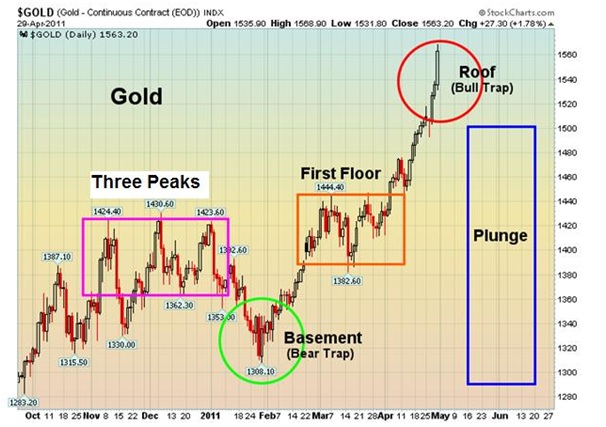
As with economists, so it is with gold analysts. There are always drastically opposing views.
Source
In London and surrounding areas which has a 10-day sleep-in but since ASX has a positive simple trading week before the Easter break it was beneficial to bring the reader up to speed on what happened in this way, especially our reaction to an amazing gold and silver prices
Which may be attractive since your dollar might be problematic again.
Well spotted. The Australian currency is playing an increasingly important role as it continues a seemingly relentless upward march. Last week saw a gain of another US2 cents with the Aussie sitting at $US1.07 just before the Easter shutdown. That means we’re up (or the U.S. is down) by 16 per cent over the past 12-months, and a whopping 51 per cent over the past 24 months.
Which also means a considerably currency drag on export earnings.
It is becoming quite painful for farmers, miners, manufacturers and the service sector. But, since we’re into mining let’s look at what happened to share prices last week as the currency effect bit into higher U.S. dollar commodity prices. Gold and silver stocks, as you might expect, did best, but not excessively. Other miners did less well. The indices tell the overall story with the gold index up 2 per cent, the all ordinaries up 1 per cent and the metals a mining industry absolutely flat.
Let’s have a quick call of the card, starting with gold and silver, please.
Before prices a very stark example of what the currency change did to last week’s record upward surge in the gold price – it turned it into a fall on conversion to Australian dollars. When we spoke a week ago the U.S. dollar gold price was US$1476/oz, and exchange rate US$1.05 to produce an Australian gold price of A$1405/oz. This week the late Thursday gold price was US$1501/oz and the exchange rate US$1.07 to produce an Australian gold price of A$1402/oz, switching a US$25/oz rise into a A$3/oz fall. Enough of the big picture stuff. Let’s move swiftly through prices.
Medusa Mining (MML) was the pick of the gold stocks with a rise of A61 cents to A$8.33. Cobar Consolidated (CCU) was the pick of the silver stocks, adding A17 cents to A$1.13. Other good gold rises came from: Kingsgate (KCN), up A31 cents to A$7.81. Troy (TRY), up A4 cents to A$3.83. Olympus (OYM) up A2 cents to A41 cents. Gold One (GDO), up A6.5 cents to A50 cents, and Dampier Gold (DAU), a newcomer but one with its foot on the old Plutonic mines in Western Australia, up A1.5 cents to 58 cents. Losing ground: Catalpa (CAH), down A10 cents to A$1.52. Ausgold (AUC), down 3 cents to A$1.59 and Noble (NMG), down A5 cents to A67.5 cents.
Base metals and iron ore next.
Not a lot of action in the non-gold sectors. Best of the copper stocks were PanAust (PNA), up A5 cents to A80.5 cents. Sandfire (SFR), up A20 cents to A$7.17. Sumatra (SUM), up A5.5 cents to A36.5 cents, and Exco (EXS), up A5 cents to A67 cents, as it heads into an interesting time over an asset sale to Xstrata. Copper stocks to lose ground included: OZ Minerals (OZL), down A2 cents to A$1.50, and Bougainville (BOC), down A4 cents to A$1.57 despite optimistic comments in Papua New Guinea that a deal is close on reopening its mothballed Panguna mine.
Nickel and zinc stocks were mixed. Western Areas (WSA), the best of the pure nickels, up A13 cents to A$7.19. Mincor (MCR) led a handful to lose ground, down A3 cents to A$1.28. Kagara (KZL) was the best of the zinc miners, up a modest A1.5 cents to A64 cents. Meridian (MII), posted the heaviest decline, down A2 cents to A10.5 cents.
Most iron ore stocks marked time, or lost a few cents. Sherwin (SHD) slipped A1 cent lower to A20 cents, with Atlas (AGO) losing the same miniscule amount of A1 cent to A$3.64. Fortescue (FMG) added A1 cent to A$6.49, and Gindalbie (GBG) recovered A2 cents to A$1.06.
Coal, uranium and the minor metals and then you can have a hot cross bun.
A mixed bag in those areas with no discernible trend ahead of the Easter break, which for us combined this year with the annual April 25 Anzac Day holiday. Coal stock to rise included: Macarthur (MCC), up A25 cents to A$12.28. Continental Coal (CCC), up A0.6 of a cent to A6.1 cents, and Guildford Coal (GUF), up A3 cents to A$1.19. Going the other way were: Carabella (CLR), down A8 cents to A$2.21. Hunnu (HUN), down A6 cents to A$1.59, and Stanmore (SMR), down A11 cents to A$1.28.
Uranium stocks slipped, which was to be expected given the fresh slide in the short-term uranium price to US$57.25 a pound. Movements included: Berkeley (BKY), down A1.5 cents to A96 cents. Deep Yellow (DYL), down A2 cents to A22.5 cents, and Manhattan (MHC), down A1 cent to A69 cents. Takeover target Mantra (MRU), and leading producer, Paladin (PDN) went against the downward trend adding A16 cents and A2 cents to A$6.83 and A$3.66 respectively
Tin explorer, Kasbah (KAS) was the best performer among the minor metals, adding A3.5cents to A30 cents. MetalsX (MLX), which has offloaded a nickel project in central Australia, rose A2 cents to A31.5 cents. Rare earth stocks were down modestly. Alkane (ALK) lost A7 cents to A$2.54 and Lynas (LYC) shed A8 cents to A$2.45.
Source
Spot gold surged to the highest on Friday in thin holiday trading, hitting a record for the sixth consecutive session as the dollar weakened and a number of factors ranging from geopolitical fears of inflation uncertainty.
Silver also raced to its loftiest in 31 years, notching the milestone for a seventh straight day and outstripping gold's weekly gains by a huge margin.
The ongoing euro zone sovereign debt crisis, unrest in the Middle East and North Africa, rising global inflation, and most recently worries over the fiscal stability of the United States have fueled the record-breaking rally in these precious metals.
Spot gold rose to an record of $1,512.50 an ounce, before easing to $1,507.69 by 0853 GMT, on track for a weekly gain of 1.5 percent -- its sixth consecutive week of gains.
Spot silver hit $46.69 an ounce, its highest since 1980, on course for a weekly rise of 8.4 percent, its biggest weekly increase in two months.
Silver has gained 51 percent so far this year, and gold 6 percent. This compares with a corresponding 1 percent rise in the London Metal Exchange price of copper, the bellwether of the industrial metals complex.
Supporting precious metals, the dollar was languishing near a three-year low against a basket of currencies, and could take a run at the all-time low hit in 2008, pressured by record low interest rates and the crushing weight of the U.S. budget deficit.
So long as the overall environment stays supportive and the dollar remains weak, gold is expected to retain its strength. Price of bullion is seen to rise to $1,700 an ounce by 2015, analysts polled by Reuters said in a poll. [ID:nLDE73K0TT]
However, a correction might be on the horizon after the recent rapid ascent, traders and analysts said.
"Gold is likely to consolidate around the $1,500-level next week," said Li Ning, an analyst at Shanghai CIFCO Futures. "The angle of the recent rally is very sharp, and we are bound to see some correction in the near term."
MORE STEAM TO RUN ON?
Spot gold has rallied more than $50, or 4 percent, in the past eight sessions. The Relative Strength Index, or RSI, rose to nearly 75, a level unseen since October last year, suggesting the market has been heavily overbought.
The RSI on spot silver climbed close to near 89, its highest
since April 1987.
The gold market may have topped out, and now is the time to
sell while there are still people willing to buy, said Barry Schwartz, vice president and portfolio manager at Toronto-based wealth manager Baskin Financial Services.[ID:nN21263459]
However, Shanghai CIFCO's Li said gold has more steam to run on and expected prices to peak at $1,550 by the end of the second quarter, buoyed by the Middle East unrest, sovereign debt concerns on both sides of the Atlantic and inflation worries.
The Shanghai Gold Exchange has started a trial for over-the-counter trading, providing a convenient tool for institutional clients to trade large quantities of gold, to catch up with exploding investment demand in China.
[ID:nL3E7FM00C]
Holdings in the physically backed exchange-traded precious metals funds dipped ahead of the long Easter weekend. SPDR Gold Trust , the world's biggest gold ETF, saw holdings dip 0.6 tonnes to 1,229.643 tonnes.
Financial markets in Singapore and Hong Kong are closed on Friday for a public holiday, and Hong Kong will remain closed on Monday.
Precious metals prices 0853 GMT
  Metal             Last    Change  Pct chg  YTD pct chg    Volume
  Spot Gold        1507.69    4.95   +0.33      6.22
  Spot Silver        46.62    0.06   +0.13     51.07
  Spot Platinum    1822.49   11.69   +0.65      3.11
  Spot Palladium    763.00   -2.48   -0.32     -4.57
  TOCOM Gold       3984.00    2.00   +0.05      6.84          622
  TOCOM Platinum   4840.00   12.00   +0.25      3.07          355
  TOCOM Silver      122.40   -0.50   -0.41     51.11          151
  TOCOM Palladium  2026.00   -3.00   -0.15     -3.39           6
  COMEX GOLD JUN1  1503.80    4.90   +0.33      5.80       112875
  COMEX SILVER MAY1  46.06    1.60   +3.59     48.87       134963
  Euro/Dollar       1.4565
  Dollar/Yen         81.93
TOCOM prices in yen per gram. Spot prices in $ per ounce.
COMEX gold and silver contracts show the most active months
Source
Copper prices in London on Wednesday climbed along with other LME base metals, supported by the weakening dollar and optimism about the prospects of the U.S. property market.
Three-month copper on the London Metal Exchange rose 1 percent to $9,437 a tonne by 0727 GMT. Copper rose 1.3 percent in the previous session, snapping a six-session run of losses.
"Perhaps the market took some solace in the U.S. housing numbers and reacted positively to it. However, it could be that it is rebounding from the day before when it got a bit carried away with S&P's threat of a U.S. sovereign credit downgrade," OSK-DMG's Chief Group Economist Thomas Lam said.
U.S. housing starts rose 7.2 percent in March to a seasonally adjusted annual rate of 549,000 units, and permits for future home construction also picked up. A typical U.S. home consumes around a fifth of a tonne of copper. [ID:nCAT005413]
Following Tuesday's strong numbers, there was a sense in the market that Wednesday's data could beat forecasts for a 2.5 percent rise in existing home sales for March.
Upcoming holidays -- with London closed for four out of the next eight trading days -- could also lead to brisk trade.
"The Easter weekend is coming up, so traders may be doubling up to clear up positions, causing base metal prices to rise in the meantime," Macquarie Bank Research Analyst Bonnie Liu said.
Copper was also supported by a weaker dollar, which dipped 0.4 percent against a basket of currencies , falling back towards a 16-month trough of 74.617 set last week.
Financial markets stumbled on Monday, sending copper to its lowest in around a month, after ratings agency S&P warned that it may downgrade the United States' AAA debt rating unless it can bring its budget deficit under control.
Shanghai's most-active copper futures contract SCFcv1 rose 1.9 percent to 71,060 yuan a tonne.
Technically, Shanghai copper could rebound into a range of 71,120 to 71,660 yuan per tonne, while LME copper could rise further to $9,488 per tonne, according to Reuters technical analyst Wang Tao.
"LME copper prices have been moving within a range of $9,000 and $10,000, only breaching that upper limit once in February before falling back quickly," Great Wall Futures Analyst Li Rong said, adding that the market may be due for an upward correction in the fourth quarter.
LME copper stocks rose 175 tonnes on Tuesday, to 451,950 tonnes, their highest since June, equivalent to a little over eight days of global supply.
In industry news, BHP Billiton reported a 19 percent jump in copper output for the March quarter, up from a year earlier when production had been disrupted by a mine accident. [ID:nL3E7FJ411]
ALUMINIUM, NICKEL RISE
LME aluminium rose 0.9 percent to $2,738, extending Tuesday's 1.5 percent rally. It touched a top of $2,741 earlier in the session, its highest since August 2008.
According to technical charts, a bullish target has been established for aluminium at $2,779 in the near term.
Earlier in the day, China ordered central and provincial authorities to stop approving the construction of new aluminium smelting capacity. [ID:nL3E7FK0JH]
China had an annual capacity of around 20 million tonnes in 2010, around 40 percent of the world's 50 million tonnes, Reuters Metal Production Database shows.
The market expects Chinese aluminium output to exceed consumption by 1 million tonnes. A concerted, effective crackdown would cut that, and if maintained, could turn the country into a net importer, with the potential to lift global prices.
Previous efforts by Beijing to rein in the sector had started to bite during late 2007 and 2008, but were relaxed during the financial crisis and in some cases replaced by incentives to expand output as China strove to maintain employment and growth.
The latest circular on the subject, however, read slightly tougher than usual, citing that individuals could be asked to take legal responsibility if state policy was not followed.
LME nickel prices rose 1.7 percent to $25,725.
"The rise in nickel prices seems to have more to do with strong physical demand than the short-term effects of the weaker dollar and better outlook for the U.S. property market. The utilisation rate in China is pretty solid, but production has also started to increase, so I don't expect prices to rally too much," said Macquarie's Liu.
Base metals prices at 0727 GMT
  Metal              Last       Change   Pct Move YTD pct chg
  LME Cu            9437.00     97.00     +1.04     -1.70
  SHFE CU FUT JUN1    71060      1340     +1.92     -1.10
  LME Alum          2738.00     24.00     +0.88     10.85
  SHFE AL FUT JUN1    16770       145     +0.87     -0.42
  HG COPPER MAY1     427.85      4.10     +1.16     -3.63
  LME Zinc          2352.00     23.00     +0.99     -4.16
  SHFE ZN FUT JUN1    17825       265     +1.51     -8.47
  LME Nickel       25725.00    425.00     +1.68      3.94
  LME Lead          2589.75     32.75     +1.28      1.56
  SHFE PB FUT SEP1    18165       185     +1.03     -1.01
  LME Tin          32734.00    334.00     +1.03     21.69
  LME/Shanghai arb    1148
Source
Comex gold futures prices hit a record high $ 1.500 / oz. Tuesday before finally returning to $ 1,400 at the end of the day, and then topped the benchmark in early trading Wednesday, blow sounded a lot like "I told you so." Gold Reports expert contributors explain what this milestone means for investors ahead.
On Kitco News, analysts were predicting that the markets would take a breather for profit-taking and evaluation before moving to whatever came next. Afshin Nabavi, head of trading at MKS Finance, was quoted describing a scenario in which profit-taking was contributing to range trading between $1,485 and $1,500/oz. before moving up again. “In every corner of the world, there is something going wrong geopolitically or economically,” Nabavi was quoted as saying. “So obviously, the safe-haven buying continues in gold and silver.”
Jay Taylor, publisher of Gold, Energy & Technology Stocks and host of the “Turning Hard Times into Good Times” radio program, said 1,500 is just a number and not really a meaningful one because the measuring stick is the dollar, which isn’t a stable unit of measure because trillions of them are being created out of nothing by government entities all the time. “It is less about an increase in the value of gold, than a devaluation of the dollar,” he said. Based on the games being played with currency in the U.S. and all over the world, he predicted that number will probably continue to climb. “The next big one will be $2,000/oz.”
The exact price of gold in dollars may not be as meaningful a number, according to Taylor, as how much an ounce of gold will buy. Based on that number, the nominal price of gold could even go down, but the relative absolute purchase price could continue to rise. “The real price of gold will remain high for a long time to come,” he said.
For that reason, Taylor is bullish on gold mining shares. He pointed to surging profit margins of aggregate gold mining shares as proof that gold is a sound investment today and for years to come. “This is the buying opportunity of a lifetime in gold mining shares,” he said.
Not everyone is listening, however. Stewart Thomson, a retired Merrill Lynch broker and author of Graceland Updates, wrote on 321Energy Tuesday that while gold has risen from $1,300/oz.–$1,500/oz., the public has actually become less interested in gold and gold stocks because “this is a crisis and greed will play a diminishing role, while fear plays an exponentially increasing role.”
The declining dollar in the wake of a Standard & Poor’s rating agency outlook downgrade and increasing oil prices signaling possible inflationary pressures was also good news for silver, which hit a 31-year high of $44/oz. on Tuesday. Taylor called it “the poor man’s gold” and said it could also hit historic highs as investors flee an unstable paper market.
James West, publisher of The Midas Letter, agreed that the worldwide counterfeiting of money is driving the demand for gold and, in his view to an ever greater degree, silver. “In terms of pure performance, whereas gold has delivered a solid gain of 26.51% in the course of the last year, silver has outshone gold spectacularly, turning in a gain of 123.55%, making it the commodity trade of the year by far.” He ventured to say that $5,000/oz. gold and $300/oz. silver could be a reality in the not too distant future.
Roger “Trader Rog” Wiegand, editor of Trader Tracks, had predicted a cyclical high for gold of $1,507/oz. and a yearly high of $1,607/oz. His silver crystal ball shows the metal rising to $45.25/oz., then as high as $51/oz. before people get scared and start getting out, leaving the wise investors to pick up and take it as high as $55.85 this year. “It’s all about cycles and time; it’s just math,” Wiegand said. Still, he didn’t think prices would reach these milestones this early in the year. He follows seven indicators and says geopolitical unrest is only one of the factors pushing prices.
An emerging trend over the last year, which he predicts will be even more prevalent by fall, is the breaking away of gold and silver shares from the rest of the stock market. “People want to be in gold and silver and they will stop paying attention to the regular markets,” Wiegand said. His revised forever high number pegs gold at $4,400/oz. and silver at $256/oz. Others have predicted even higher highs. Analyst Alf Field has suggested $10,000/oz. and Economist Martin Armstrong has publicly said $12,000/oz.
We, at The Gold Report, will be watching to see if precious metals reach the high bars being set.
Streetwise – The Gold Report is Copyright © 2011 by Streetwise Reports LLC. All rights are reserved. Streetwise Reports LLC hereby grants an unrestricted license to use or disseminate this copyrighted material (i) only in whole (and always including this disclaimer), but (ii) never in part.
The GOLD Report does not render general or specific investment advice and does not endorse or recommend the business, products, services or securities of any industry or company mentioned in this report.
From time to time, Streetwise Reports LLC and its directors, officers, employees or members of their families, as well as persons interviewed for articles on the site, may have a long or short position in securities mentioned and may make purchases and/or sales of those securities in the open market or otherwise.
Streetwise Reports LLC does not guarantee the accuracy or thoroughness of the information reported.
Streetwise Reports LLC receives a fee from companies that are listed on the home page in the In This Issue section. Their sponsor pages may be considered advertising for the purposes of 18 U.S.C. 1734.
Participating companies provide the logos used in The Gold Report. These logos are trademarks and are the property of the individual companies.
Source
The price of gold passed $ 1,500 in Hong Kong has further supported this far in Europe, while silver continued to increase even faster than its brother.
The gold price did push through $1500 Wednesday morning in early European and late Asian trading, but at this psychological ‘barrier' a fair amount of computer-generated profit taking has already started to come in, although perhaps less than anticipated, and the plus $1500 mark has been maintained - or at least it has in the US dollar. Continuing dollar weakness has seen gold fall back in both the Euro and the Pound sterlingl. (Silver has been an even bigger beneficiary, at least in dollars, and breached $46 0n Thursday - surely still heading for $50.)
But, despite perhaps not quite such a strong performance in other currencies it is nonetheless a major dollar barrier which has been broken and the likelihood would appear to be that in the next few days and weeks, as the European economic malaise continues to feature in the news, the U.S. economic recovery disappoints, doubts about China's short term growth prospects and the ongoing fighting and tensions in Africa and the Middle East, the gold price will at some stage probably consolidate these latest gains and move on to yet new highs as any profit-taking dissipates and buying pressure continues. Indeed if a significant advance above this level comes about $1500 could even become the new ‘floor' for the gold price. The next major resistance level is seen as $1520-$1525 providing the $1500 level is maintained through Easter.
Barclays Capital noted some support for this viewpoint in a research report earlier in the week that gold had been affected by significant selling pressure at the start of the year on the back of a run of positive macro data. Since then, the report commented, the year's low prices have been propelled higher by a raft of factors supporting investor demand (mostly those noted above) which have outweighed some recent rate hikes to drive prices to fresh highs.
But overall, as we have mentioned before, the rising gold price is also an indication of the debasement of the U.S. currency in particular through the excess printing of ‘fiat' money in an attempt to stave off a major global economic depression. European nations are similarly guilty of printing excessive amounts of unbacked currency. In retrospect whether this will be seen by history as a positive move or not obviously remains to be seen. It has as many detractors as supporters among mainstream economists.
With negative interest rates actually supportive of holding gold, which of course does not generate interest - a fact which has been considered a significant reason for not buying gold by the metal's detractors in the past - we are likely set for further rises, although May to August has often proved a period of price weakness or consolidation prior to a take-off in late Summer, early Fall.
Other precious metals have been dragged up along with gold, although one needs to be a little more cautious here perhaps because if one of the reasons for gold's rise is continuing doubts about the economy then those precious metals with a significant industrial usage - notably platinum and palladium - and to an extent silver - thus have perhaps to be more vulnerable.
Silver, though may actually be in a different bracket. It still has momentum, and its past monetary role somehow gives it a gold-like credibility as a safe haven metal and its relatively low price in relation to gold means it is particularly attractive to the smaller investor. However should sentiment towards it change it too could be vulnerable and there are plenty of analysts out there - including some usually strong silver bulls - who are nervous that it may have moved up too far too fast, although they remain positive longer term. But meantime it is steadily moving towards $50 - a level which only six months ago would have seemed incredible!
Source
Gold surged to record highs on Friday after the dollar fell to its lowest point since late 2009 against major currencies, along with silver on the highest position in 31 years, while inflation pressures in China also helped lift bullion's appeal.
China's turbo-charged growth eased just a touch in the first quarter, while its inflation jumped to a 32-month high, putting pressure on the government to do more to rein in prices and keep the economy on an even keel. [ID:nL3E7FF0AC]
Spot gold was steady at $1,472.50 ounce by 0824 GMT, having hit a record high of $1,479.01 an ounce.
Gold is still far below its all-time inflation-adjusted high, estimated at more than $2,000 an ounce set in 1980 as a result of heightened geopolitical pressure and hyper inflation.
"We see gold peaking at $1,500 an ounce. We think there could be some more upside in gold in the short term, especially in this environment of high inflation and rising oil prices," said" Natalie Robertson, commodities strategist at ANZ.
"There is a lot more upside," said Robertson, adding that the peak of $1,500 would be reached by the end of 2011.
Dealers said worries about inflation had spurred steady physical demand from China, where the government has vowed to use all tools at its disposal, including bank reserve requirements, interest rates and the yuan's exchange rate, to wrestle inflation under control. [ID:nL3E7FD1LJ]
Gold's rise to a record only attracted light selling from Thailand and Indonesia, suggesting that investors remained bullish on the outlook. Premiums for gold bars were steady at between 70 cents and $1 an ounce in Singapore.
"Generally, higher consumer prices could still be a boost for gold. Going forward, we will be looking at inflation figures from the United States, and if we see an upside surprise, gold can even go higher," said a dealer in Singapore.
"If you look at recent price action when China announces interest rate hikes, it hasn't affected commodities that much. Also, because of the fact that gold prices are already so expensive, investors are looking at silver as a store of value."
Spot silver rose as high as $42.41 an ounce, its strongest since 1980, with physical dealers in Singapore also reporting buying from speculators.
IShares Silver Trust said its holdings edged up to 10,974.26 tonnes by April 14 from 10,969.71 tonnes on April 13. The holdings hit a record of 11,242.89 tonnes hit on April 8.
The dollar dropped to its lowest in more than a year, under pressure from expectations the U.S. Federal Reserve will not cut short its $600 billion debt-buying programme despite the recent surge in oil prices. [ID:nN14167673]
U.S. consumer price inflation numbers due at 1230 GMT will be closely watched for signs inflation may be rising faster than the Fed may expect.
U.S. gold futures for June rose as high as $1,480.5 an ounce, a lifetime high.
The Singapore Mercantile Exchange (SMX) started trading cash-settled gold futures on Friday, with the contract for June delivery opening at $1,475 an ounce on low volumes.
[ID:nL3E7FF03J]
"They need sufficient liquidity before people start looking at the contracts," said the Singapore-based dealer.
"It's always difficult to get people to adopt a new contract. You'd always stick to traditional, old benchmarks, such as COMEX gold."
Brent crude held steady above $122 a barrel on Friday after China's economic growth beat forecasts despite government efforts to cool expansion and put the brakes on inflation.
Precious metals prices 0824 GMT
Metal             Last    Change  Pct chg  YTD pct chg    Volume
  Spot Gold        1472.50   -0.40   -0.03      3.74
  Spot Silver        41.89   -0.19   -0.45     35.74
  Spot Platinum    1785.00   -1.49   -0.08      0.99
  Spot Palladium    767.97    7.34   +0.96     -3.94
  TOCOM Gold       3943.00  -19.00   -0.48      5.74         2430
  TOCOM Platinum   4808.00  -22.00   -0.46      2.39          361
  TOCOM Silver      111.90   -1.50   -1.32     38.15          175
  TOCOM Palladium  2060.00  -13.00   -0.63     -1.76           40
  COMEX GOLD JUN1  1473.60    1.20   +0.08      3.67        21682
  COMEX SILVER MAY1  41.92    0.25   +0.60     35.47        16768
  Euro/Dollar       1.4457
  Dollar/Yen         83.08
TOCOM prices in yen per gram. Spot prices in $ per ounce.
COMEX gold and silver contracts show the most active months
Source
China's absence from the copper market has dampened confidence in the bullish on the annual conference of the world's largest copper in Chile, before staging a rebound.
Even if copper prices plunge soon, as industry players gathered here expect with China sitting on the bench, the top copper consumer is seen returning to the market and driving prices to new highs by year end.
China's absence from the copper market has dampened bullish conviction at the world's biggest annual copper conference in Chile, with copper CMCU3 prices seen sinking around 20 percent in coming months from life highs of $10,190 tonnes in February, before staging a rebound.
Speculation has been rife as to whether China will return to the spot market this quarter, with many industry insiders expecting purchases to be delayed and pointing to rising warehouse stocks MCU-STOCKS.
"You will get volatility, and I think that is what we are seeing right at this moment in time. But its going to be a short-term volatility period," said Andrew Harding, CEO of Rio Tinto's (RIO.L) copper unit chief executive.
"But the longer-term story actually says there's good demand and that supply is actually struggling to keep up," he added.
Harding believes the world copper supply deficit could hit half a million tonnes this year and that the shortage could extend beyond 2013. His view for the year is wider than the market consensus of around 400,000 tonnes.
Credit Suisse expects Chinese demand to remain robust, citing a divergence between apparent consumption data and underlying demand.
"While the weakness in the physical market is unambiguous, indicators for underlying demand have remained strong," the bank said in a research report.
"We believe this gap will be closed primarily through a rebound in imports and refined production. Recent draws of non-bonded Shanghai Futures Exchange stocks may be the first sign that this transition is already underway," it added.
China's interest rate hikes are fanning fears of a deeper slowdown. The Chinese central bank raised rates on Tuesday for the fourth time since October as it seeks to counter price pressures in the world's top base metals consumer.
A source at a small Chinese copper merchant, which buys just 2,000 tonnes of refined copper and 300,000 tonnes of concentrate a year, said the company had no plans to buy from the spot market because of rising capital costs and negative arbitrage of Shanghai-LME.
"An interest rate rise is not good news for the copper price," he said.
Fears of more cut backs in China mixed with strong market fundamentals has left some at the conference feeling deflated.
"Usually I leave this conference feeling bullish copper, but this year it's different. It's not bearish, it's flat," said a banking source.
But there are some bright spots. Some see signs of a tightening in China's scrap market, the first stop to source metal before moving to the open market.
"China is out of the market and has been for six months.
That's not sustainable, even with interest rate rises. After working through quite a few cycles, the fact they're not buying now doesn't spook me at all," said a trader at a large Swiss merchant.
Source
"Buy or sell?" This question investors constantly ask myself. There are, of course, there is no universal right answer. It depends too much on the person, or a corporation’s, specific circumstances. In theory everyone acknowledges the veracity and wisdom of buying when there is blood in the streets, or straw hats in winter. But in practice it is extremely difficult to do because everyone is concerned that bad things can get worse. And when the sun is shining no one can conceive of things being anything other than bright and shiny.
In part these attitudes can be put down to age. Once you’ve lived through a few crises another one just seems par for the course. Youngsters find each new drama unsettling which is one reason perhaps that contrarian investing is always so unpopular. Few people have the sagacity of Warren Buffet, who recommends investing in Japan now. But the reassuring factor about wars, insurrections, earthquakes and tsunamis is that they are not monetary. They were not caused by financial speculation.
It might be fair to say that many insurrections in the Arab world were, ultimately, caused by the greed of their despotic rulers. And if that is the case, and if the era of the greedy despot is passing, then the changes that are now underway will have far reaching and deep rooted consequences. What every country needs before its economy can really take-off, as China’s and India’s have done, is a burgeoning middle class.
Such a class was never allowed to develop in Tunisia, Egypt, Libya or Syria. The elite did not want to share their wealth with their countrymen. But if these revolutions succeed, and it is hard to envisage the populace being content with the old order now, it could mark the start of a massive surge of growth in countries that historically have had no significant economic footprint. Like the Indians and the Chinese, Arabs are famous for their trading and entrepreneurial skills. Ally that with oil resources, and the potential for creating wealth is phenomenal.
This global uncertainty has unsurprisingly triggered a correction in some growth correlated asset classes, such as equities and commodities, in recent weeks. Base metals in contrast, as measured by the LME index, continue to make good progress. A gain of 2.9 per cent on the week takes the rise over the year to date to six per cent. It might not be dramatic, but it puts the asset class in a healthy situation relative to others.
What is interesting is the rotation within the sector. Copper led the way initially and breached the US$10,000 a tonne barrier but has since drifted back and is essentially flat on the year at US$9,700. In contrast, aluminium has made steady progress over that period and is up 5.7 per cent at US$2,595 a tonne. Like copper, nickel has drifted back from its peak but unlike the red metal is still showing an eight per cent gain on the year. Lead has been a bit more subdued but is still 5.4 per cent to the good over the year. It is only zinc that has let the side down with its 2.4 per cent slide but a modest 20,000 tonne increase in LME inventories to 735,000 tonnes provides a reasonable explanation.
It would be easy to us the current news flow as an excuse to sell out of growth assets like metals and mining shares. But if these changes in the Maghreb become embedded and allow the region properly to join the democratic capitalist world, then the scope for growth and increased metal demand must be positive. Even today the bulk of metal demand comes from a handful of countries like the USA, China, Germany and Japan. Anything that allows that list to grow is good news, even if it doesn’t feel like it at the time.
Source
Metal inserted into the relatively calm day with an average gain of 0.1 percent and the average range plus minus 1.1 percent to 0.7 percent. Nickel led on the way down with a 1.1 percent drop to $26,400, while tin was the best performer with a 1.5 percent gain. Equities in Europe and the US failed to follow on from the strength seen in Asia on Tuesday morning and the dollar was generally quiet – so a day of consolidation.
This morning the metals are more buoyant with average gains of 0.8 percent, with zinc leading the advance with a 2.3 percent gain to $2,373. Interestingly zinc had been lagging behind the rebound in the other metals so is now showing signs of catching up. Copper is up 0.6 percent at $9,540. Volumes remain relatively quiet with 1,894 lots of copper, 1,430 lots of zinc and 661 lots of aluminium traded. Total volume has been 3,768 lots as of 7am GMT.
In Shanghai the June contracts are up an average of 1.5 percent, zinc is up 3 percent at Rmb 18,600, copper is 1 percent higher at Rmb 71,980 and aluminium is up 0.4 percent at Rmb 16,830. Spot copper in Changjiang lags the futures with a 0.4 percent gain to Rmb 71,350-71,600, so remains in contango, while the LME/Shanghai arb remains negative at $210/tonne.
The Shanghai Futures Exchange (SHFE) will start trading lead futures tomorrow. The contract period for the futures will range from September 2011 to May 2012. The daily limit on price movements will be 6%.
Equities – the Dow dipped yesterday, it closed down 0.2 percent, the Nikkei is down 1.7 percent, the Hang Seng is off 0.3 percent, the MSCI Asia Apex is down 0.2 percent and China’s CSI 300 is bucking the trend with a 1.3 percent increase. Concerns over the spread of radiation and further production delays have weakened the Nikkei as that refocuses the market on the short term issues, rather than the medium term recovery outlook.
The dollar has picked up slightly – the dollar index is at 75.52, the recent low was 75.25. The euro is down at 1.4180, the pound is strong at 1.6376, the aussie is last at 1.0096 and the yen is strong at 80.83. Gold is firm at $1,429, as is silver at $36.35 and oil is high at $105.00. Strong oil and any rebound in the dollar may well provide some headwinds.
The economic calendar is fairly busy, Portugal’s government is voting on austerity measures, the UK budget is being announced and various central bankers are talking, including Fed Chairman Bernanke. On the data front he focus will be on EU new industrial orders and US new home sales, see table below for more details
On balance the rebounds off last week’s lows are continuing as prices stretch to the upside and gradually recoup ground lost in the aftermath of the earthquake in Japan. Whether the current economic environment warrants continued price rises is a moot point – our overall view is that the short to medium term consequences of the earthquake and higher oil prices should be negative for metal prices. However, perhaps buyers are strong enough to look further forward. A lot is likely to depend on whether broader confidence remains robust or whether it suffers if companies start to be affected by supply-chain issues.
6:59 AM +/- +/- % Lots
Cu 9540 60 0.6% 1894
Al 2597 6.75 0.3% 661
Ni 26518 118 0.4% 119
Zn 2373 53 2.3% 1430
Pb 2693 16 0.6% 388
Sn 30250 100 0.3% 24
Steel Med 0 0 0.0%
Time Country Period ACTUAL Expected Previous
9:30am UK MPC Meeting Minutes 3-0-6 3-0-6
9:30am UK BBA Mortgage Approvals 29.4K 28.9K
10:00am EU Industrial New Orders m/m 1.4% 2.6%
11:00am US FOMC Member Fisher Speaks
12:30pm UK Annual Budget Release
2:00pm EU Belgium NBB Business Climate 5.1 5.8
2:00pm US New Home Sales 291K 284K
2:30pm US Crude Oil Inventories 2.0M 1.7M
3:00pm EU Consumer Confidence -11 -10
4:00pm US Fed Chairman Bernanke Speaks
11:50pm JPN Trade Balance 0.68T 0.19T
Source
The metals sold off heavily intraday yesterday, at the day’s lows average losses were 2 percent, with lead dropping the most with a 4.2 percent drop to $2,378 9 - up until yesterday it had been holding up well, while copper dropped 1.8 percent to $9,115. However, once oil prices started to retreat the metals attracted bargain hunting and they went on to close mixed and in a broad range either side of unchanged with zinc and aluminium 0.4 percent higher, while lead was down 1.1 percent and copper was off 0.6 percent – so certainly a choppy day’s trading. Most of the charts have been quite badly damaged, the exception being aluminium, although the underlying tails put in on most of the metals do show good bargain hunting interest into yesterday’s close.
This morning the metals are under pressure again with the massive 8.8 magnitude earthquake in north-eastern Japan shaking markets. Average losses across the LME as of 07:05 were 0.5 percent, copper is down 0.5 percent at $9,175, while lead has dropped the most, it is down 1.1 percent to $2,327. Volumes are average, although the focus remains on copper that has traded 3,177 lots out of total volume of 5,116 lots.
Equities – the Dow fell 1/9 percent yesterday and Asia is weak on the back of the US and the earthquake, with the Nikkei down 1.7 percent, the Hang Seng is down 1.5 percent, The MSCI Asia Apex is down 1.6 percent and China’s CSI 300 index is down 0.8 percent.
The yen has weakened to 83.20, the aussie is 0.9985, the pound is down at 1.6045 and the euro is at 1.3800, which translates into a stronger dollar with the dollar index at 77.29. Gold is firmer at $1,415, Silver is at $35.24 and oil is weaker at $100.96.
In Shanghai the May contracts are mixed, copper is down 0.3 percent at Rmb 69,340, aluminium is little changed at Rmb 16,770 and zinc is up 0.2 percent at Rmb 17,755. Spot Changjiang copper picked up 0.6 percent to Rmb 69,550-69,800 – suggesting the pull back has attracted some restocking which has put the market in a backwardation. The LME/Shanghai arb has widened further to negative $340/tonne, while the zinc arb has moved negative again.
Today’s economic agenda is busy. Chinese data has already been released and shows a mixed picture, industrial production was stronger than expected as was PPI and fixed asset investments, but retail sales were lower than expected. German WPI was also more than expected. Later we get US retail sales and University of Michigan consumer sentiment and inflation expectations, plus the EU summit continues as ministers search for direction on Libya and the EU debt crisis. See table for more details on the data.
The metals face numerous cross currents as trading opens up in Europe, the earthquake in Japan has weakened equities in Asia and before that equities in the US were weak anyway. There are reports that copper production facilities and power facilities have also been shut in the region. The dollar is firmer and that is likely to provide a headwind for the metals, however, weaker oil prices should give the markets something to cheer about. In Europe there are increased strains on the debt situation and that might add downward pressure to the euro and raise overall concern.
On balance the metals generally look heavy, although in recent days they have already fallen quite far and therefore there may be more bargain hunting. The pull back in oil prices may well provide further incentive for bargain hunters. However, with today being Friday and the day of potential heightened unrest in the Middle East, oil could rally again. With equities and underlying market sentiment focused on the Middle East and oil we would expect events in the Middle East to drive sentiment, but the impact of the earthquake and today’s economic events are likely to have an impact too. Overall therefore we would expect a choppy and nervous day’s trading – but would be on the look out for bargain hunting.
7:05 AM +/- +/- % Lots
Cu 9175.75 -50.25 -0.5% 3177
Al 2578 -9 -0.3% 549
Ni 25945 -120 -0.5% 200
Zn 2280 -10.25 -0.4% 919
Pb 2427 -28 -1.1% 261
Sn 29700 0 0.0% 10
Steel Med 0 0 0.0%
Time Country Period ACTUAL Expected Previous
China CPI y/y 4.9% 4.8% 4.9%
2:00am China Industrial Production y/y 14.1% 13.3% 13.5%
2:00am China NBS Press Conference
2:00am China PPI y/y 7.2% 7.0% 6.6%
2:00am China Retail Sales y/y 15.8% 19.0% 19.1%
2:09am China Fixed Asset Investment ytd/y 24.9% 23.3% 24.5%
7:00am EU German Final CPI m/m 0.5% 0.5% 0.5%
7:00am EU German WPI m/m 1.4% 1.0% 1.2%
All Day EU EU Economic Summit
9:30am UK PPI Input m/m 1.4% 1.7%
9:30am UK PPI Output m/m 0.7% 1.0%
1:30pm US Core Retail Sales m/m 0.7% 0.3%
1:30pm US Retail Sales m/m 0.8% 0.3%
1:30pm US FOMC Member Dudley Speaks
2:55pm US Prelim UoM Consumer Sentiment 77
2:55pm US Prelim UoM Inflation Expectations 3.4%
3:00pm US Business Inventories m/m 0.6% 0.8%
8:45pm UK BOE Gov King
Source
Minera Andes Inc. (TSX:MAI) discovers 7.5 kilometres of new new high-grade silver/gold veins at its San Jose Mine, Argentina, during exploratory drilling in 2010, the company reported on Thursday.
The new veins represent a 44% increase in the cumulative strike length of all veins known at the mine at the end of 2009. In addition, drilling in 2010 through September 30th produced a doubling of the inferred mineral resource, as previously reported on November 22, 2010. The new veins are located within the area of the existing San José mining operations between the Kospi and Frea veins, and access for the new veins will be developed from existing underground mine workings. The discoveries are the result of a significant increase in the exploration effort at San José compared to previous years.
“These drill results demonstrate that the area in and around the San José mine is extremely prospective,” said Chair and CEO Rob McEwen, adding:
“We are eagerly awaiting the results of the ongoing exploration drilling in and outside the mine area. The recent $3.6 billion acquisition of Andean Resources’ for its nearby Cerro Negro property by Goldcorp Inc. highlights the world class potential of this emerging gold/silver district.”
Minera Andes has a 49% interest in Minera Santa Cruz SA, owner of the San Jose Mine, which lies in close proximity to Goldcorp’s Cerro Negro project. The company also owns the Los Azules copper deposit with an inferred mineral resource of 10.3 billion pounds of copper and an indicated resource of 2.2 billion pounds of copper.
The company has USD$31 million in its treasury and no debt. McEwen owns 31% of the shares.
For further information please access the source of this news or for more details please click here
Bullion prices bottomed before settling higher in Wednesday early afternoon business, falling following positive US jobs data before dip buying emerged, although the complex remains under pressure after reports emerged that President Chavez of Venezuela was attempting to broker a peace deal in Libya.
- Spot gold struck an intraday low of $1,417.60 per ounce, retreating further from the record of $1,440.40 struck yesterday before bouncing. It was last at $1,425.65/1,426.45 per ounce, down $7.50. On the charts, having broken support at the seven-day moving average of $1,418, next levels stand at $1,417 and $1,408. Resistance is capped at $1,438, $1,440 and $1,442.
- US data showed 368,000 new unemployment claims last week, below an expected 394,000 and down from 388,000 in the previous week - this itself was reduced from 391,000. Revised non-farm productivity for the fourth quarter grew 2.6 percent, as forecast and matching the previous three-month period. Earlier the European Central Bank decided to keep interest rates on hold at one percent, despite growing inflationary fears there.
- The euro punched further gains against the dollar and rose to a new high since November 9 at 1.3969. It was last seen at 1.3943, up more than three quarters of a cent. European equities remained upbeat, rising 1.2-1.3 percent, while US futures were also pointing higher ahead of the New York opening bell.
- Among other precious metals, silver stooped to an intraday low of $34.16 per ounce before recovering to trade at $34.55/34.60, down six cents. Platinum and palladium were indicated at $1,837/1,842 and $816/821 per ounce respectively, down $9 and $2.
Source
MMTC Ltd., India’s largest state-run trading company, will boost imports of South African gold, coal, nickel and chrome after opening its first office in the country.
MMTC agreed with South Africa’s FirstRand Ltd. to buy 15 metric tons of gold for about $70 million in 2011 and may boost coal imports to about 15 million tons from 12 million tons last year, Marketing Director Ved Prakash said today. The company also plans to build a diamond-cutting factory in South Africa.
Indian demand for South Africa’s coal contributed to Asia overtaking Europe in 2009 as the largest shipping destination for the fuel used in power plants. Last year, Richards Bay Coal Terminal Ltd., which ships most of South Africa’s coal, sent 59 percent to Asia and a quarter to Europe. India imported about 800 tons of gold last year, making it the world’s largest buyer.
Indian consumption of gold is “insatiable,” the country’s Commerce and Industry Minister Anand Sharma said at the opening of the office in Johannesburg. In addition, five of every six diamonds produced in the world go to India, Sharma said.
MMTC’s move into South Africa, the largest platinum and ferrochrome maker, will boost trade with India and cut costs, South African Trade and Industry Minister Rob Davies said.
AngloGold Ashanti Ltd., Gold Fields Ltd. and Harmony Gold Mining Co. are South Africa’s largest gold producers, while Anglo American Plc, BHP Billiton Ltd., Exxaro Resources Ltd. and Xstrata Plc are among the largest coal producers.
source
A fresh move by China to curb inflation undermined copper and oil prices on Friday while a battle over control of banks in Ivory Coast sent cocoa to a one-year peak and Mideast unrest boosted gold and silver.
The news that China's central bank raised lenders' required reserves by 50 basis points sent a chill through some markets as investors worried that more monetary tightening would cut demand in the world's biggest consumer of commodities.
Markets sought to balance Chinese moves to cool the economy -- including a rate hike earlier this month -- with strong underlying fundamentals in copper, including an expected shortage of metal to meet global demand this year.
"The Chinese move this morning to raise the reserve ratio is a continuation of policy tightening that we expect will persist for some time yet," said Nic Brown, analyst at Natixis in London.
"There is potential for base metal prices to correct lower soon. Tin, copper, nickel are more susceptible to this correction compared with other metals. We don't see a collapse but a correction... fundamentals are still positive."
In the wake of the news from China, benchmark copper on the London Metal Exchange dipped 0.5 percent to $9,763 a tonne by 1130 GMT. The metal used in power and construction hit a record peak of $10,190 earlier this week.
The Chinese move also dampened sentiment on oil markets, although continued tensions in the Middle East and North Africa were a counter-balance, having helped lift Brent crude above $100 a barrel about two weeks ago.
Brent crude futures were up 10 cents at $102.69 a barrel, down from earlier gains to $103.50 a barrel. The U.S. March light crude contract shed 28 cents to $86.08.
GOLD, SILVER STRONG
The persistent unrest in the Middle East boosted safe-haven gold to a five-week peak and sister metal silver skipped to the highest levels in 31 years.
"(There has been) a remarkable move in silver, which has helped gold back towards $1,400," said Saxo Bank senior manager Ole Hansen.
"Middle East/North African unrest was undoubtedly the trigger, but it looks like investors have been waiting for the opportunity to buy at lower levels, and once that opportunity disappeared they returned for fear of missing the move."
Gold fell more than 6 percent in January, but many investors had been waiting for further losses to re-enter the market.
Spot gold gained to $1,385.70 against $1,383.30 late in New York on Wednesday, while silver climbed to $31.84 against $31.74, having hit a high of $31.95, a 31-year peak in earlier trade.
source
Gold rose above $1,390 an ounce on Friday, notching its best weekly performance since December, underpinned by fears over a European debt crisis, rising inflation and growing unrest in the Middle East.
Bullion’s gains sparked strong investment buying in silver, which soared to 31-year high, further widening silver’s gains over gold and sending the gold-silver ratio to its lowest level in 13 years.
“There is a big concern over the weekend that we can see some problems with the EU sovereign debt, in particular there are worries that Portugal may need a bailout very soon. Gold as a safe haven is certainly back in focus,” said Bill O’Neill, partner of commodities firm LOGIC Advisors.
The yield on five-year Portuguese government bonds hit a fresh euro lifetime high on Friday, after a euro zone source told Reuters the bloc is increasingly concerned about Portugal’s fiscal conditions and believed Lisbon will need to seek a bailout by April.
Gold also benefits as a safe haven as worries about the political stability of the region have flared this week, with unrest spreading after protests in Tunisia and Egypt unseated leaders there.
Spot gold rose 0.3 percent to $1,386.75 by 2:34 p.m. EST, having earlier hit a five-week high of $1,391.75. Bullion has risen in the five straight sessions, the longest streak since September. It gained almost 3 percent for the week.
U.S. gold futures for April delivery settled up $3.50 at $1,388.60 an ounce, with volume about 50 percent below its 30-day norm. That was in line with recent lower-than-normal turnover, a possible sign of dwindling trading interest.
Silver gained 2.1 percent to $32.42 after hitting a high of $32.86, its strongest level since 1980.
The gold/silver ratio — the number of ounces of silver needed to buy an ounce of gold — dropped to its lowest in 13 years at under 43 on Friday, Reuters data showed, as silver prices outperformed.
Silver’s rise was driven by short-term speculation and buying related to option hedging strategies, as the backdrop of an improving economy lifted the industrial metal, analysts said.
Investment demand for the largest silver-backed exchange-traded fund iShares Silver Trust has also shown signs of stabilizing after hefty outflows last month.
Barclays Capital said in a note it expects silver to continue to outperform gold, with silver trading as high as $37 an ounce.
CHINA’S TIGHTENING IGNORED
Gold initially pared gains after China said it was raising lenders’ reserve requirements by 50 basis points but remained firmly underpinned by investment interest in precious metals.
“The hike in Chinese reserve requirements has clearly taken a back seat as the investor focus has been on developments in the Middle East, especially Bahrain,” said Pradeep Unni, senior analyst at Richcomm Global Services in Dubai.
Simmering tensions across the Arab are supporting gold, as thousands in Bahrain took to the streets on Friday and funerals were expected in two Libyan towns as both countries mourned victims of government crackdowns on protesters. Anti-government protests were also reported in Yemen.
Gold buying spiked this week after data showed U.S. core consumer prices rose 0.2 percent in January, the fastest pace in more than a year, indicating a long period of slowing inflation had run its course. Earlier this week, strong Chinese core inflation had also boosted gold.
The technical picture has also sharply improved this week, with prices breaching key resistance levels, including bullion’s 50-day and 100-day moving averages, analysts said.
Platinum dropped 0.5 percent to $1,832.99 an ounce, while palladium gained 0.8 percent to $847.72, having earlier touched a 10-year high at $855.47.
Prices at 2:21 p.m. EST
LAST/ NET PCT YTD
CLOSE CHG CHG CHG US gold 1388.60 3.50 0.3% -2.3% US silver 32.296 0.726 0.0% 4.4% US platinum 1843.30 -0.70 0.0% 3.7% US palladium 857.70 14.70 1.7% 6.8%
Gold 1387.80 4.50 0.3% -2.2% Silver 32.41 0.67 2.1% 5.0% Platinum 1832.24 -10.50 -0.6% 3.6% Palladium 846.72 5.75 0.7% 5.9%
Gold Fix 1383.50 -2.00 -0.1% -1.9% Silver Fix 31.94 133.00 4.3% 4.3% Platinum Fix 1836.00 3.00 0.2% 6.1% Palladium Fix 847.00 4.00 0.5% 7.1%
Source
