Spot gold is relatively stable on Monday, after slipping nearly 1 percent in the previous session, while the dollar mixed - down against the euro but rose versus some other currencies, and holidays in Australia, is expected to create anxiety in the trade.
FUNDAMENTALS
* Spot gold fell 4 cents to $1,530.99 an ounce by 0118 GMT, after ending last week half a percent lower.
* U.S. gold edged up 0.2 percent to $1,532.30.
* The dollar fell 0.1 percent versus the dollar, by rose 0.05 percent against a currency basket .DXY.
* Bullion came under pressure after Wall Street resumed its slide following weaker Chinese trade data last week..N
* More data is scheduled to be released from the world's top gold producer, including inflation where the market expects a small rise to 5.4 percent in consumer prices.
* Support for gold was seen at its 20-day moving average of $1,524, a level it has held for the past three weeks.

* Silver rose 0.2 percent to $36.21 after slipping more than 3 percent on Friday.
Precious metals prices 0118 GMT
Metal Last Change Pct chg YTD pct chg Volume
Spot Gold 1530.99 -0.04 -0.00 7.86
Spot Silver 36.21 0.08 +0.22 17.34
Spot Platinum 1825.24 1.49 +0.08 3.27
Spot Palladium 811.75 1.80 +0.22 1.53
TOCOM Gold 3972.00 -8.00 -0.20 6.52 30344
TOCOM Platinum 4772.00 -3.00 -0.06 1.62 3269
TOCOM Silver 93.90 -2.40 -2.49 15.93 650
TOCOM Palladium 2108.00 13.00 +0.62 0.52 149
COMEX GOLD AUG1 1532.30 3.10 +0.20 7.80 3704
COMEX SILVER JUL1 36.24 -0.09 -0.25 17.11 6724
Euro/Dollar 1.4337
Dollar/Yen 80.50
TOCOM prices in yen per gram. Spot prices in $ per ounce.
COMEX gold and silver contracts show the most active months
Source
Trade volume this year experienced at least indicate the movement of the silver market is safer than gold as is often suggested
Silver's high fix, when it was way overbought, was $48.70 on April 28th. Gold held up briefly as silver toppled over, but as the commodities sector as a whole got caught up in the onslaught, gold in particular, was sold in order to raise cash against margin calls. Gold's high fix was $1,546.50 on the morning of 3rd May.
The speed of the falls of these two metals is well-documented, but for the record, silver dropped to a low fix of $32.50 in 12th May, while gold fell to a low fix of $1,478.50 on 17th May. These were falls of 33% and just 4% respectively. On an intraday basis the price declines represented the unwinding of part of the most recent very sharp upward legs that had commenced in late January. Silver's move was unwound by 75% and while gold's correction was obviously much shallower, it was still over 40% of the post-January move.
Gold's post-August 2009 uptrend has been by no means severed and in the immediate term gold would have to drop towards $1,450 before the support came under threat. Silver moved into more perilous territory, but here, too the overall medium term uptrend - discounting the March-April spike - is also intact.
So what of the flows of funds in and out of the markets while these moves have been taking place? Silver is often cited as a much smaller market than gold, with this accounting in part for its higher price volatility. The approximate value of last year's mine production, for example (taking the annual average price) was $14.9 billion, while that of gold was $106 billion, seven times as large as silver. Trading patterns have been shifting and recent silver activity, on a pro rata basis compared with mine supply, has been much larger than that of gold.
Gold turnover in the first-continuation on COMEX last year, at $5.5 trillion, was 4.1 times as much as silver's first-continuation turnover. Silver volumes have rocketed this year, however and gold turnover of 2.8 trillion in the year to late May was only 1.6 times as much as that of silver. Between the start of this year and the third week of May, silver turnover on Comex had reached $1.7 trillion, thus exceeding turnover of the whole year, while the daily average volume (based on turnover and daily close) at $17 billion, compared with $5 billion daily in 2010 - and this, it must be remembered, was merely the first-position contract.
COMEX first-position silver turnover, contracts and $M

Source: Thomson Reuters, MineWeb
The gold:silver ratio since the start of this year has averaged 41.8:1 (compared with 62.1:1 in 2010), so this recent performance is pretty impressive; whether it can be sustained, however is open to some doubt as the metal's recent price performance is likely to deter some speculators and investors. Silver is renowned for this kind of capricious behaviour and this recent short sharp shock is likely to scare away more than just the faint-hearted, suggesting that the gold:silver ratio should continue to widen.
COMEX speculators have already been voting with their feet. The CFTC figures for 24th May show that speculative silver longs were 9,386 tonnes and shorts were 3,949 tonnes, giving a net position of 5,437 tonnes. At its recent peak on 5th April, the net speculative long was 8,773 tonnes, comprised of 13,047 tonnes of longs and 4,273 tonnes of shorts. In other words, the combined speculative long+short position in early April was almost 17,200 tonnes and by late May it was down by 23%. The actual recent low was the previous week and there was a smidgeon of fresh long side interest in the following week so there is some tentative interest returning to the market, but we are unlikely to scale the April highs in the foreseeable future.
Meanwhile in the major Exchange Traded instruments, the net inflow of funds into silver between late January and the price peak was $760 million. Some $1.4 billion left the funds during the correction, and a further outflow of more than $660 million has taken place since. Roughly $790 million when into the major gold funds while between late January and the peak in early May, while in the correction the funds lost $1.2 billion. Since then, however, although there were subsequent outflows the gold funds have stated turning round and have enjoyed fresh net investment of over $150M, giving us additional evidence that while gold is moving back into favour, silver market players may still tread with caution for the time being.
Source
Having lost assets in the DRC in difficult circumstances, First Quantum has filed the best legs in Zambia, and reap the results of efforts
London- and Toronto-listed First Quantum this week posted solid results for first-quarter 2011, and headlined its objective to produce 300,000 tonnes of copper in 2011 as a whole, and 200,000 ounces of gold, extracted as by product from two of its copper mines.
First Quantum's founding base of business, the central African copperbelt, straddling Zambia and the Democratic Republic of the Congo, has recently come into focus with the bid by Barrick, the world's biggest gold miner, for Toronto- and Australia-listed Equinox, which mines copper in Zambia, and is due to start mining copper in Saudi Arabia, where it also holds interests in gold-base metal projects. Barrick already produces copper, but is the first major gold miner to consciously bid for a copper miner.
Good copper miners are making very good money. Cynics may well point to Barrick's spin off of African Barrick Gold in 2010, which was listed in London, and in which Barrick remains the biggest shareholder. The apparent contradictions are explained mainly by the above-average stock market valuations commanded by gold stocks, and the relative undervaluation of copper stocks, which can produce genuinely impressive cash flows and profits.
The African copper belt boasts some of the world's highest in situ copper grades, and, in some cases, by-product cobalt, gold, or silver, and even uranium. First Quantum pioneered the resuscitation of the ruined once-nationalised copper mines in the central African copper belt, when it acquired Bwana Mkubwa in Zambia in the mid-1990s. First Quantum was soon mining just across the border in the DRC, at Lonshi, and achieved rapid growth on both sides of the border, attracting interest and investment to the broader area.
But the DRC has proved a bitter pill for First Quantum, which saw its in-build KMT operation in the copper-rich southern Katanga Province seized in 2009, and onsold via a British Virgin Islands (BVI) shell structure. During 2010, First Quantum's Frontier mine was shuttered after further action by DRC authorities. It can be noted that upon the shuttering, various expats were noted on the mine premises, not least Tim Henderson and John Gross, who are, apparently, GM and metallurgist at a Glencore interest in the DRC, known as Mutanda Mine Mumi Copper/Cobalt Project. Approached at the time, early September 2010, for comment, Glencore politely declined.
Both the KMT and Frontier cases are now in international arbitration, in Paris and Washington, respectively. First Quantum is separately suing London-listed ENRC over its announcement that it acquired a majority stake in KMT, via the BVI conduits.
Some kind of revenge seems to be on the menu on the Zambian side of the border. First Quantum recently highlighted the award to it of fresh mining permits in Zambia, which continues to attract foreign investment despite heated debates, and action, and some retraction, on tax issues, over the past few years. In Katanga Province, the only major miner present at the operational level until recently was Freeport-McMoRan, the major shareholder in and operator of Tenke Fungurume, an inheritance, as such, from an earlier acquisition by Freeport-McMoRan.
Earlier this month, First Quantum hosted a high profile groundbreaking at its Trident project in Zambia, where over 140,000 meters of drilling has been completed in more than 380 holes. Based on First Quantum's internally-generated resource estimates, the group is proceeding with the design of a project at Trident that could produce 150,000 tonnes of copper a year, initially, and then expand to 300,000 tonnes of copper. First Quantum is also headed towards producing material amounts of nickel, in Australia and Finland. While First Quantum heads back to its roots with Trident, its expansion from a small base in the mid-1990s has seen it become one of the world's most-demanded copper stocks.
The first major miner to make conscious moves on the central African copperbelt, at least at the operational level, is Brazilian supergroup Vale, the world's No 2 miner, which recently bid for Johannesburg-listed Metorex, which operates in both the DRC (Ruashi) and Zambia (Chibuluma and Sable Zinc). Vale already has an interest in Zambia's Konkola North, which, according to Vale, ranks as the second-largest known resource on the Zambian copperbelt. This is an underground mine with estimated nominal production capacity of 44,000 metric tonnes a year of copper in concentrate, with production scheduled to start up in 2013. This project is part of a joint venture with Johannesburg-listed African Rainbow Minerals.
Early in 2009, Vale acquired a 50% interest in a joint venture with ARM for CAD 81m, with the objective of looking at developing nominal production capacity of 65,000 metric tons of copper a year, at Konkola North and Kalumines. The joint venture also holds extensive further exploration interests.
And then there is Toronto- and London-listed Katanga Mining, which was bailed out by Glencore in 2008 and 2009, in the wake of turmoil in markets generally. Early in 2008, Katanga Mining completed its merger with Nikanor, which held the giant KOV pit, adjacent to Katanga Mining's Kamoto interests.
London-listed Nikanor raised USD 380m in cash upon listing in July 2006, and USD 777m a year later. Upon the business combination of Nikanor and Katanga Mining, USD 446m in cash was returned to Nikanor shareholders, as a capital repayment, or special dividend. The prime beneficiaries were the three major Nikanor founding shareholders: Beny Steinmetz, the UK-based Gertner family, and Daniel Gertler.
JP Morgan Cazenove, pushers of the Nikanor float, were keen to remind investors that the KOV deposits boast one of the highest-grade major copper ore bodies in the world, with 172m tons of indicated mineral resources at an astonishing grade of 5.09% copper, plus a wonderful grade of 0.49% cobalt.
And yet Katanga Mining continues to burn cash, even after yet another rights issue in 2009, which raised USD 245m, entrenching Glencore as the controlling shareholder. During first-quarter 2011, Katanga Mining produced copper metal and concentrate of 18,385 (first-quarter 2010: 12,458) tonnes and 635 (889) tonnes of cobalt. So-called C1 cash costs for the first-quarter 2011 were USD 1.82 (USD 1.34) per pound of copper.
In a filing on 31 March 2011, Katanga Mining described its New Phase 4 expansion which, once completed, is expected to result in total plant capacity of 310,000 tonnes of copper a year. How this is to be financed is yet to be fully described. Equity investors in Katanga Mining have seen the company's issued shares increase from 78m in 2008 to 1.9bn at this point in time.
For some investors, a pall remains over mining in the DRC, particularly in Katanga Province, not least on the kind of reception that the spat between First Quantum and ENRC has been given by parts of the London-based media. While Vale has shown something of an appetite for becoming involved in Katanga Province, its focus in the broader region is without question to the east in Tete Province, Mozambique, where Vale is busy commissioning the USD 1.7bn Moatize coal mine, alongside Toronto- and Australia-listed Riversdale's deposits.
Katanga Mining
USD m
1Q11
1Q10
2010
2009
2008
Operating cash flow
60
81
167
-180
-45
Capital expenditure
-51
-31
-218
-118
-439
Free cash flow
9
50
-52
-298
-484
Equity raised
245
Cash on hand
44
127
30
77
32
Debentures
-124
-117
-120
-113
-258
Net debt
-81
10
-90
-36
-227
Moatize holds resources of more than 1bn tonnes; Moatize I has a nominal production capacity estimated at 11m tonnes of coal, 80% coking. The coal will be transported along the Linha do Sena railway to the historic Beira port. Earlier this year, the first train seen in 25 years arrived at Moatize town.
At Beira, the Mozambique government is building a new facility to handle an additional 18 to 24m tonnes of coal a year. Other transnational companies with a presence in Tete include ENRC, Nippon Steel, Jindal and ETAStar.
Vale, also a global leader in logistics, has bought a 51% stake in Sociedade de Desenvolvimento do Corredor do Norte SA (SDCN), which controls the Corredor de Desenvolvimento do Norte (CDN) and the Central East African Railways (CEAR). CDN holds a concession over 872km of railroad in Mozambique; CEAR holds a concession over 797km of railroad in Malawi. The "first prize" in the network would be access to Katanga Junction, which has historic railroads running in literally all directions. The vast majority are rusted and ruined.
Riversdale and Tata earlier this year bought the balance of shares in Benga Power Project, a USD 1bn investment progressing to initial production in 2013-2014, to produce around 550MW of power, with the objective of increasing to 2,000MW. The miners are also looking at barging along the Zambezi River, following precedents from decades ago.
Riversdale is, of course, headed towards delisting with transnational miner Rio Tinto now holding more than 70% of the shares in Riversdale. At the same time, Rio Tinto has sold out of the huge Chapudi coking coal deposit in South Africa, to Coal of Africa Limited. With corporate action in South Africa and Katanga Province likely to remain subdued for the foreseeable future, which could be quite a while, more corporate action with a Zambian focus could be on the cards.
Which leads back to First Quantum, with its plans to grow to a remarkable 1m annual tonnes of copper, as early as 2015, from the 2011 outlook of 300,000 tonnes. The Kiwara PLC acquisition - now called Sentinel copper and Enterprise nickel - with USD 1bn of capex should add 400,000 tonnes a year of copper, plus, First Quantum has discovered a significant nickel orebody on the Zambian property, 150km from its flagship Kansanshi Mine.
With the Ravensthorpe project in Australia (acquired from BHP Billiton) targeted to produce around 40,000 tonnes a year of nickel from the end of 2011, plus Kevitsa in Finland, at 10,000+ tonnes a year from mid-2012, First Quantum is building a significant nickel stream.
First Quantum
USD m
1Q11
1Q10
2010
2009
2008
Operating cash flow
379.3
164.7
731.3
562.6
765.4
Capital expenditure
-189.3
-44.8
-357.6
-361.8
-460.3
Free cash flow
190.0
119.9
373.7
200.8
305.1
Cash on hand
1486.4
548.4
1344.9
919.2
176.2
Debt
-530.9
-608.0
-613.1
-630.0
-385.7
Net cash/debt
955.5
-59.6
731.8
289.2
-209.5
The bottom line is that First Quantum has put the disappointment of losing its DRC assets far behind. First Quantum has firmly emerged as a challenger to London-listed Antofagasta's place as the No 2 base metal company in the world behind Freeport-McMoRan. When Barrick officially opens operational offices in Zambia, the game could well be on.
Selected DRC/Zambia stocks
* 12-month ** DRC only *** Cameroon **** Congo-Brazzaville
Copper-cobalt
Stock
From
From
Value
price
high*
low*
USD bn
NFC
CNY 33.27
-24.1%
200.8%
3.273
First Quantum
CAD 127.92
-13.8%
165.4%
11.397
Katanga Mining**
CAD 1.97
-9.7%
239.3%
3.881
Equinox
CAD 8.09
-4.0%
163.5%
7.356
Metorex
ZAR 7.13
-4.2%
132.2%
1.057
Anvil**
CAD 6.08
-15.8%
129.4%
0.989
Mwana Africa
GBP 0.07
-51.0%
5.8%
0.061
Tiger Resources
AUD 0.53
-18.0%
200.0%
0.377
African Copper
GBP 0.04
-45.7%
0.0%
0.049
Africo**
CAD 1.16
-35.6%
52.6%
0.086
Caledonia
CAD 0.11
-37.1%
100.0%
0.057
African Eagle
GBP 0.11
-33.6%
206.9%
0.074
Geovic***
CAD 0.55
-44.4%
31.0%
0.059
El Nino Ventures
CAD 0.15
-21.6%
383.3%
0.018
Averages/total
-25.6%
143.6%
28.733
Weighted averages
-12.7%
171.2%
Gold stocks
Banro**
CAD 3.40
-22.9%
112.5%
0.670
AngloGold Ashanti
USD 45.59
-13.8%
19.8%
17.379
Randgold Resources
USD 79.90
-24.9%
13.9%
7.273
Mwana Africa
GBP 0.07
-51.0%
5.8%
0.061
Mexivada****
CAD 0.12
-36.1%
15.0%
0.006
Gilla Inc.
USD 0.02
-82.0%
42.9%
0.001
Loncor Resources**
CAD 3.29
-12.3%
406.2%
0.196
Diversified
Freeport-McMoRan
USD 50.67
-17.4%
80.3%
48.004
OM Group
USD 36.91
-7.5%
68.0%
1.144
Vedanta
GBP 21.70
-17.5%
20.9%
9.411
Lundin
CAD 8.83
-5.2%
203.4%
5.310
ENRC
GBP 8.69
-24.5%
8.4%
18.253
Source: market data; table compiled by Barry Sergeant
Source
Conditions when the price of gold and silver experienced a sharp correction was anticipated by some commentators, although the speed and depth of the sell-off might not be expected, but interesting now that some of those who called the top of the already suggested that it may be time to move back in.
Notable among these is Peter Grandich of the well respected Grandich Letter who recommended selling gold and silver right at the top and is already telling readers to start climbing back in. Grandich says: "After literally getting out within minutes of the top in silver and gold and then watching a decline I anticipated could take weeks or months happen in a matter of days, I believe it's time to go back in and buy back those positions. I may be 10% too early but we have plenty of room given what we sidestepped. So I'm now back in fully in gold and silver."
Looking at what has happened in the past week, gold has lost, from peak to current levels, just under $100 - a fall of around 6% which is not massive in the scheme of things. Silver though has lost around 30% from its peak. Momentum had carried it up far faster than was reasonable and at least one commentator had described the silver price surge, and subsequent fall back, as "an accident waiting to happen". It had risen too far too fast and to an extent the euphoria so generated had probably been partly responsible for dragging gold up a little faster than expected, or warranted.
In a similar manner, silver's initial stumble, and then sharp plunge, may have also been a factor in gold losing its lustre.
But the sell-off hasn't just been in precious metals. Revived general doubts about global economic strength have run over into most commodities, with investors scrambling for what they see as a safe haven - but in this respect it has been the dollar they have turned to, rather than gold and there has been a recovery in the dollar index over the past day or so which has been another contributing factor in the precious metals' decline.
More sober analysis suggests, though, that the dollar is not worthy of a revival as long as the U.S. Fed keeps on pumping money out to the banks, and then supposedly to the U.S. economy as a whole - although there are serious doubts about how much of this government largesse is actually filtering down the line. History tells us that money printing on this kind of scale eventually has to lead to inflation - indeed to severe inflation. Perhaps the banks' sticky fingers have to an extent prevented this from happening so far with the government money finding its way to the investment community and boosting the stock markets rather than the economy as a whole. - Another bubble waiting to burst?
Indeed all the factors which had led to the rise of gold - we'll leave silver out of it for the moment because it was speculative fervour largely responsible for that metal's over the top advance - are still with us, and at some stage the investment community will recognise this and move back into gold as the haven of preference. Whether that will happen now - or later in the year, remains to be seen.
Long term gold proponent, Jim Sinclair, who has quite a following, advises gold holders to "relax". He's looking for a major upturn in gold as soon as June and is still targeting $5,000 as a longer term objective. This seems far-fetched - but then people would have said that about $1,000 gold, let alone $1500, only two or three years ago.
As for silver, will we see another meteoric rise if gold does recover first. Perhaps too many people got their fingers burnt in the recent rise for a similar surge to happen in the short to medium term, and there could still be ground here for further falls befor the price stabilises and starts to rise again. Maybe a return to a gold:silver ratio of nearer 45:1 or higher (currently 42.5) may be on the cards before real progress starts to be made again here.
On the bearish side, however, there are those who suggest that the decline in gold and silver may not be done yet. Technical analyst, Dr Nu Yu, points to a "Three Peaks and a Domed House" chart pattern - I guess this means something to the technical analysis community - suggesting a gold price fall of 17% to around $1290 by June, but offers no further projections beyond then. His chart is shown below courtesy of www.munknee.com.
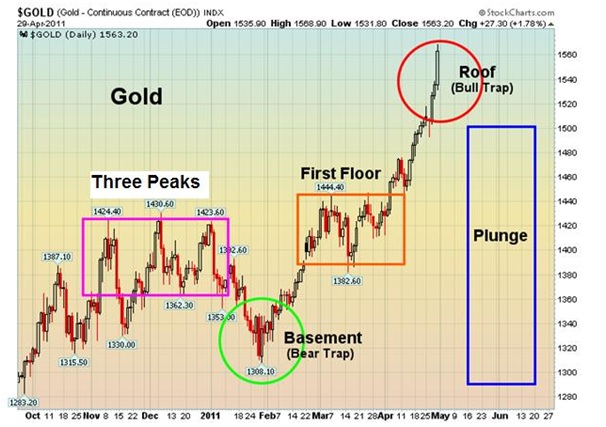
As with economists, so it is with gold analysts. There are always drastically opposing views.
Source
COMEX silver fell 3% on Wednesday, fell for the third straight session, and gold faltered as precious metals are under pressure to improve after a strong rally in recent weeks.
However, the overall trend in gold and silver remain bullish, as concerns on rising global inflation, unrest in the Middle East and North Africa, and low U.S. interest rates drive investors to park their value in precious metals.
"On the way up, it (silver) was too fast and now we are seeing a general liquidation of long positions," said a Singapore-based trader.
"Silver has been falling much faster than gold, but it doesn't mean that silver will collapse from here."
Gold hit record highs in 11 out of past 14 sessions and spot silver has surged more than 20 percent since mid-April to a 31-year high just below $50 on April 28.
The immediate support level for silver is seen around $39, its 50-day moving average, he added.
COMEX silver SIcv1 hit a near three-week low of $40.47 earlier. It shed 3 percent to $41.30 an ounce by 0326 GMT, extending an 8-percent loss from Tuesday, after the CME Group hiked margin requirement for the third time in a week.
Higher margins make speculation more expensive, adding to the pressure on silver prices.
Spot silver fell by 0.9 percent to $41.26.
Investment interest in silver ebbed, as holdings in the iShares Silver Trust , the world's biggest silver-backed exchange-traded fund, dropped to a seven-week low of 10,909.06 tonnes, 4 percent off the record high hit on April 25.
The gold-silver ratio, used to measure how many ounces of silver is used to buy an ounce of gold, recovered to above 37 from below 32 last week, its lowest since early 1980s.
Spot gold declined 0.5 percent to $1,532.60 an ounce, headed for a third straight day of loss.
COMEX gold GCcv1 also lost half a percent to $1,533.20.
CHINA INFLATION OUTLOOK
Chinese inflation is expected to moderate in the second half of the year as government measures to curb price rises hit their mark, said a senior central bank official. [ID:nL3E7G403Y]
The statement is unlikely to dampen the long-term sentiment in gold, traders and analysts said.
"It doesn't turn the market around. All the actions will only slow down the pace of inflation," said the Singapore-based trader.
China has raised interest rates four times since last October and banks' required reserve ratio to a record level, to fight stubborn inflation.
"China's rate hikes tend to have a rather short-lived impact on global gold market," said Li Ning, an analyst at Shanghai CIFCO Futures. "The key is when the U.S. will start raising interest rates."
The European Central Bank, which has raised interest rates last month, is expected to signal its readiness to hike rates again when it meets on Thursday. [ID:nLDE7420ZV]
Precious metals prices 0326 GMT
  Metal             Last    Change  Pct chg  YTD pct chg    Volume
  Spot Gold        1532.60   -7.78   -0.51      7.97
  Spot Silver        41.26   -0.38   -0.91     33.70
  Spot Platinum    1846.49   -6.82   -0.37      4.47
  Spot Palladium    771.00  -12.69   -1.62     -3.56
  TOCOM Gold       4072.00  -15.00   -0.37      9.20        22271
  TOCOM Platinum   4904.00   41.00   +0.84      4.43         3055
  TOCOM Silver      118.70    1.30   +1.11     46.54         1953
  TOCOM Palladium  2030.00  -17.00   -0.83     -3.20          197
  COMEX GOLD JUN1  1533.20   -7.20   -0.47      7.87         6745
  COMEX SILVER JUL1  41.30   -1.29   -3.02     33.48         6822
  Euro/Dollar       1.4794
  Dollar/Yen         80.94
  TOCOM prices in yen per gram. Spot prices in $ per ounce.
  COMEX gold and silver contracts show the most active months
Source
Spot gold surged to the highest on Friday in thin holiday trading, hitting a record for the sixth consecutive session as the dollar weakened and a number of factors ranging from geopolitical fears of inflation uncertainty.
Silver also raced to its loftiest in 31 years, notching the milestone for a seventh straight day and outstripping gold's weekly gains by a huge margin.
The ongoing euro zone sovereign debt crisis, unrest in the Middle East and North Africa, rising global inflation, and most recently worries over the fiscal stability of the United States have fueled the record-breaking rally in these precious metals.
Spot gold rose to an record of $1,512.50 an ounce, before easing to $1,507.69 by 0853 GMT, on track for a weekly gain of 1.5 percent -- its sixth consecutive week of gains.
Spot silver hit $46.69 an ounce, its highest since 1980, on course for a weekly rise of 8.4 percent, its biggest weekly increase in two months.
Silver has gained 51 percent so far this year, and gold 6 percent. This compares with a corresponding 1 percent rise in the London Metal Exchange price of copper, the bellwether of the industrial metals complex.
Supporting precious metals, the dollar was languishing near a three-year low against a basket of currencies, and could take a run at the all-time low hit in 2008, pressured by record low interest rates and the crushing weight of the U.S. budget deficit.
So long as the overall environment stays supportive and the dollar remains weak, gold is expected to retain its strength. Price of bullion is seen to rise to $1,700 an ounce by 2015, analysts polled by Reuters said in a poll. [ID:nLDE73K0TT]
However, a correction might be on the horizon after the recent rapid ascent, traders and analysts said.
"Gold is likely to consolidate around the $1,500-level next week," said Li Ning, an analyst at Shanghai CIFCO Futures. "The angle of the recent rally is very sharp, and we are bound to see some correction in the near term."
MORE STEAM TO RUN ON?
Spot gold has rallied more than $50, or 4 percent, in the past eight sessions. The Relative Strength Index, or RSI, rose to nearly 75, a level unseen since October last year, suggesting the market has been heavily overbought.
The RSI on spot silver climbed close to near 89, its highest
since April 1987.
The gold market may have topped out, and now is the time to
sell while there are still people willing to buy, said Barry Schwartz, vice president and portfolio manager at Toronto-based wealth manager Baskin Financial Services.[ID:nN21263459]
However, Shanghai CIFCO's Li said gold has more steam to run on and expected prices to peak at $1,550 by the end of the second quarter, buoyed by the Middle East unrest, sovereign debt concerns on both sides of the Atlantic and inflation worries.
The Shanghai Gold Exchange has started a trial for over-the-counter trading, providing a convenient tool for institutional clients to trade large quantities of gold, to catch up with exploding investment demand in China.
[ID:nL3E7FM00C]
Holdings in the physically backed exchange-traded precious metals funds dipped ahead of the long Easter weekend. SPDR Gold Trust , the world's biggest gold ETF, saw holdings dip 0.6 tonnes to 1,229.643 tonnes.
Financial markets in Singapore and Hong Kong are closed on Friday for a public holiday, and Hong Kong will remain closed on Monday.
Precious metals prices 0853 GMT
  Metal             Last    Change  Pct chg  YTD pct chg    Volume
  Spot Gold        1507.69    4.95   +0.33      6.22
  Spot Silver        46.62    0.06   +0.13     51.07
  Spot Platinum    1822.49   11.69   +0.65      3.11
  Spot Palladium    763.00   -2.48   -0.32     -4.57
  TOCOM Gold       3984.00    2.00   +0.05      6.84          622
  TOCOM Platinum   4840.00   12.00   +0.25      3.07          355
  TOCOM Silver      122.40   -0.50   -0.41     51.11          151
  TOCOM Palladium  2026.00   -3.00   -0.15     -3.39           6
  COMEX GOLD JUN1  1503.80    4.90   +0.33      5.80       112875
  COMEX SILVER MAY1  46.06    1.60   +3.59     48.87       134963
  Euro/Dollar       1.4565
  Dollar/Yen         81.93
TOCOM prices in yen per gram. Spot prices in $ per ounce.
COMEX gold and silver contracts show the most active months
Source
The price of gold passed $ 1,500 in Hong Kong has further supported this far in Europe, while silver continued to increase even faster than its brother.
The gold price did push through $1500 Wednesday morning in early European and late Asian trading, but at this psychological ‘barrier' a fair amount of computer-generated profit taking has already started to come in, although perhaps less than anticipated, and the plus $1500 mark has been maintained - or at least it has in the US dollar. Continuing dollar weakness has seen gold fall back in both the Euro and the Pound sterlingl. (Silver has been an even bigger beneficiary, at least in dollars, and breached $46 0n Thursday - surely still heading for $50.)
But, despite perhaps not quite such a strong performance in other currencies it is nonetheless a major dollar barrier which has been broken and the likelihood would appear to be that in the next few days and weeks, as the European economic malaise continues to feature in the news, the U.S. economic recovery disappoints, doubts about China's short term growth prospects and the ongoing fighting and tensions in Africa and the Middle East, the gold price will at some stage probably consolidate these latest gains and move on to yet new highs as any profit-taking dissipates and buying pressure continues. Indeed if a significant advance above this level comes about $1500 could even become the new ‘floor' for the gold price. The next major resistance level is seen as $1520-$1525 providing the $1500 level is maintained through Easter.
Barclays Capital noted some support for this viewpoint in a research report earlier in the week that gold had been affected by significant selling pressure at the start of the year on the back of a run of positive macro data. Since then, the report commented, the year's low prices have been propelled higher by a raft of factors supporting investor demand (mostly those noted above) which have outweighed some recent rate hikes to drive prices to fresh highs.
But overall, as we have mentioned before, the rising gold price is also an indication of the debasement of the U.S. currency in particular through the excess printing of ‘fiat' money in an attempt to stave off a major global economic depression. European nations are similarly guilty of printing excessive amounts of unbacked currency. In retrospect whether this will be seen by history as a positive move or not obviously remains to be seen. It has as many detractors as supporters among mainstream economists.
With negative interest rates actually supportive of holding gold, which of course does not generate interest - a fact which has been considered a significant reason for not buying gold by the metal's detractors in the past - we are likely set for further rises, although May to August has often proved a period of price weakness or consolidation prior to a take-off in late Summer, early Fall.
Other precious metals have been dragged up along with gold, although one needs to be a little more cautious here perhaps because if one of the reasons for gold's rise is continuing doubts about the economy then those precious metals with a significant industrial usage - notably platinum and palladium - and to an extent silver - thus have perhaps to be more vulnerable.
Silver, though may actually be in a different bracket. It still has momentum, and its past monetary role somehow gives it a gold-like credibility as a safe haven metal and its relatively low price in relation to gold means it is particularly attractive to the smaller investor. However should sentiment towards it change it too could be vulnerable and there are plenty of analysts out there - including some usually strong silver bulls - who are nervous that it may have moved up too far too fast, although they remain positive longer term. But meantime it is steadily moving towards $50 - a level which only six months ago would have seemed incredible!
Source
Gold surged to record highs on Friday after the dollar fell to its lowest point since late 2009 against major currencies, along with silver on the highest position in 31 years, while inflation pressures in China also helped lift bullion's appeal.
China's turbo-charged growth eased just a touch in the first quarter, while its inflation jumped to a 32-month high, putting pressure on the government to do more to rein in prices and keep the economy on an even keel. [ID:nL3E7FF0AC]
Spot gold was steady at $1,472.50 ounce by 0824 GMT, having hit a record high of $1,479.01 an ounce.
Gold is still far below its all-time inflation-adjusted high, estimated at more than $2,000 an ounce set in 1980 as a result of heightened geopolitical pressure and hyper inflation.
"We see gold peaking at $1,500 an ounce. We think there could be some more upside in gold in the short term, especially in this environment of high inflation and rising oil prices," said" Natalie Robertson, commodities strategist at ANZ.
"There is a lot more upside," said Robertson, adding that the peak of $1,500 would be reached by the end of 2011.
Dealers said worries about inflation had spurred steady physical demand from China, where the government has vowed to use all tools at its disposal, including bank reserve requirements, interest rates and the yuan's exchange rate, to wrestle inflation under control. [ID:nL3E7FD1LJ]
Gold's rise to a record only attracted light selling from Thailand and Indonesia, suggesting that investors remained bullish on the outlook. Premiums for gold bars were steady at between 70 cents and $1 an ounce in Singapore.
"Generally, higher consumer prices could still be a boost for gold. Going forward, we will be looking at inflation figures from the United States, and if we see an upside surprise, gold can even go higher," said a dealer in Singapore.
"If you look at recent price action when China announces interest rate hikes, it hasn't affected commodities that much. Also, because of the fact that gold prices are already so expensive, investors are looking at silver as a store of value."
Spot silver rose as high as $42.41 an ounce, its strongest since 1980, with physical dealers in Singapore also reporting buying from speculators.
IShares Silver Trust said its holdings edged up to 10,974.26 tonnes by April 14 from 10,969.71 tonnes on April 13. The holdings hit a record of 11,242.89 tonnes hit on April 8.
The dollar dropped to its lowest in more than a year, under pressure from expectations the U.S. Federal Reserve will not cut short its $600 billion debt-buying programme despite the recent surge in oil prices. [ID:nN14167673]
U.S. consumer price inflation numbers due at 1230 GMT will be closely watched for signs inflation may be rising faster than the Fed may expect.
U.S. gold futures for June rose as high as $1,480.5 an ounce, a lifetime high.
The Singapore Mercantile Exchange (SMX) started trading cash-settled gold futures on Friday, with the contract for June delivery opening at $1,475 an ounce on low volumes.
[ID:nL3E7FF03J]
"They need sufficient liquidity before people start looking at the contracts," said the Singapore-based dealer.
"It's always difficult to get people to adopt a new contract. You'd always stick to traditional, old benchmarks, such as COMEX gold."
Brent crude held steady above $122 a barrel on Friday after China's economic growth beat forecasts despite government efforts to cool expansion and put the brakes on inflation.
Precious metals prices 0824 GMT
Metal             Last    Change  Pct chg  YTD pct chg    Volume
  Spot Gold        1472.50   -0.40   -0.03      3.74
  Spot Silver        41.89   -0.19   -0.45     35.74
  Spot Platinum    1785.00   -1.49   -0.08      0.99
  Spot Palladium    767.97    7.34   +0.96     -3.94
  TOCOM Gold       3943.00  -19.00   -0.48      5.74         2430
  TOCOM Platinum   4808.00  -22.00   -0.46      2.39          361
  TOCOM Silver      111.90   -1.50   -1.32     38.15          175
  TOCOM Palladium  2060.00  -13.00   -0.63     -1.76           40
  COMEX GOLD JUN1  1473.60    1.20   +0.08      3.67        21682
  COMEX SILVER MAY1  41.92    0.25   +0.60     35.47        16768
  Euro/Dollar       1.4457
  Dollar/Yen         83.08
TOCOM prices in yen per gram. Spot prices in $ per ounce.
COMEX gold and silver contracts show the most active months
Source
GFMS Executive Chairman Philip Klapwijk isn't big on publishing prognostications for the research group's World Silver Survey 2011 report produced for Washington's Silver Institute.
After some prodding by Mineweb, Klapwijk said he expect silver prices to remain in the "top $20s" this year. The Silver Survey noted, "Booming silver investment was the primary source of the astounding 78% intra-year [between January and December] increase in silver prices in 2010."
World investment demand leapt to 279.3 million ounces last year, which GFMS estimated was roughly equivalent to a net inflow of $5.6 billion into silver. Implied net investment rose by 47% to 178 million ounces, with most of the demand concentrated in ETFs and physical bullion bars. GFMS noted coins and medals demand was also strong last year with offtake increasing 28% to a record 101.3 million ounces.
The boom will apparently continue as the 2011 silver price average $31.86 per ounce over the first quarter of this year. However, GFMS observed, "As regards the outlook for prices, GFMS are positive, but cautiously so."
"We believe the economic backdrop for investment will in general remain supportive as monetary policy is unlikely to be tightened that much in 2011 and inflation and sovereign debt concerns will most probably grow further," GFMS suggested. "This will encourage investment demand for silver and, importantly, gold on whose coat-tails silver so often rides. Additional support should also flow through from ongoing solid gains in industrial demand."
Silver mine production increased by 2.5% last year, thanks to new projects in Mexico and Argentina, reaching a record high of 735.9 million ounces . Substantial increases were also recorded for China and Australia.
"Many of the gains at the mine level in 2010 came not from the start of new operations, but from the build-up in production from projects commissioned in 2009, many of which were still undergoing expansion at the end of 2010," said the survey. "Central to the rise were properties in Mexico, where primary silver mines added 9.0 Moz (280 t), helping establishing it as the largest silver production country in 2010.
While Mexico reported a 13% rise in silver production to a high of 128.6 million ounces, Peru dropped to number two in silver mine production rankings. Supply from Peru fell by 6% or 7.4 million ounces as two of the largest primary silver mines-Hochschild's Arcata and Buenaventura's Uchucchacua.
GFMS predicted, "Silver mine production is expected to record another annual increase in 2011, with increases across the gold, silver and lead/zinc sectors."
Primary silver mines accounted for 46% of the gross global increase in silver mine production last year. Production of silver from other metals posted a mixed performance.
For the second successive year, silver mine cash costs were relatively flat year-on-year, averaging $5.27 per ounce.
"Last year saw a dramatic return to net producer hedging, with 61.1 Moz added to the global hedge book, a volume just short of the 1997 record high, lifting the global hedge book at year-end to 86.7 Moz," the survey said.
The most significant hedging activity last year came from Minera Frisco, which made numerous additions to its hedge book at year-end, covering silver, gold and base metal production. GFMS calculated that Frisco's hedge position totaled 50.3 million ounces on a delta-adjusted basis, with 24.8 million ounces of forwards, and the balance comprise of options.
Net government sales of silver increased by 188% to 44.8 million ounces in 2010 as GFMS estimated that total government silver stocks stood at 109.6 million at the end of the year.
Meanwhile silver bullion imports into China, Hong Kong and Singapore fell last year, while South Korean and Japanese bullion imports grew markedly due to recovery in industrial offtake, GFMS advised.
Last year world silver fabrication demand grew 12.8% to 878.8 million ounces, which came within touching distance of the previous record high of 900.7 million ounces of offtake set in 2000. Industrial demand rebounded by 21% last year to 487.4 million ounces, which GFMS attributed to the easing of the global recession and pipeline restocking.
Silver demand in photographic applications fell by 8% in 2010, which GFMS said is "the first single digit percentage drop seen in five years." Meanwhile jewelry fabrication rose to a five-year high of 167 million ounces.
Klapwijk was scheduled to present the World Silver Survey 2011 report at a New York City conference Thursday morning.
Source
Gold and silver futures made history on Wednesday, with the highest value due to the position of the investors collectively take a safe position on precious metals, in addition to the weakening U.S. dollar will worsen the condition.
Gold notched a settlement and an intraday record high and set its sights on $1,500 an ounce. Silver stopped just pennies short of the psychologically important $40-an-ounce level, hitting a 31-year high on its way.
Gold for June delivery (GCM11 1,457, -1.40, -0.10%) rose $6, or 0.4%, to settle at $1,458.50 an ounce on the Comex division of the New York Mercantile Exchange.
The contract climbed as high as $1,463.70 an ounce earlier, according to a preliminary tally available at the CME Group’s website. CME owns and operates Comex.
The settlement and the intraday nominal records supplanted the previous milestones reached just the previous day.
“The geopolitical situation is going from bad to worse,” said Afshin Nabavi, head of trading at MKS Finance in Geneva. “Everybody is talking about gold at $1,500 [an ounce].
As soon as gold breached through the $1,450-$1,450 mark, fresh money came in as some investors scrambled to be part of the rally, Nabavi added.
Gold at $1,500 is certainly possible in the short term, although a more orderly, slower rise over the next month or two would be more desirable, he said.
The metal hit a record of $875 an ounce in January 1980 — the equivalent of $2,350 an ounce in today’s dollars.
In addition to ongoing fighting in Libya, where rebel forces and government forces continue to vie for the upper hand in a NATO-led military intervention, Europe’s debt crisis came back to the fore this week as Portugal appeared to get closer to asking for a bailout.
“Prices are likely to remain buoyant as risk aversion increased on the back of Moody’s downgrade of Portugal’s credit rating,” analysts at ICICI Bank wrote to clients. Moody’s Investors Service cut Portugal’s rating by one notch to Baa1 from A3 on Tuesday, saying a bailout for Portugal seemed very likely.
The focus on Portugal intensified as the country had to pay hefty yields to sell short-term bonds on Wednesday. Investors are concerned that a rescue for Portugal will also rock Spain, an economy bigger than Portugal, Ireland and Greece combined.
Portugal’s finance minister said his country will need a bailout from the European Union, according to media reports Wednesday. Finance Minister Fernando Teixeira dos Santos reportedly told the Jornal de Negocios that Portugal will need to “resort to the financing mechanisms available within the European framework.”
A finance-ministry spokeswoman confirmed the comments, according to Reuters. European Union officials, however, have yet to receive a formal bailout request from Portugal, according to The Wall Street Journal’s online edition.
Meanwhile, silver for May delivery (SIK11 3,940, +0.80, +0.02%) rose 20 cents, or 0.5%, to $39.39 an ounce — the latest in a string of 31-year highs for the metal.
Investors kept their sights on silver at $40, and some believe it would be only a short time from that to the nominal record above $50 an ounce that spot silver hit in January 1980.
The broader suite of metals were mostly stronger, with copper for May delivery (HGK11 435.70, -1.30, -0.30%) rallying 11 cents, or 2.5%, to $4.37 a pound as miner bellwether Rio Tinto PLC (RIO 72.80, -0.17, -0.23%) predicted an even tighter market for copper than most analysts expected.
Palladium and platinum diverged, however. June palladium (PAM11 787.05, +2.45, +0.31%) declined $8.50, or 1.1%, to settle at $784.60 an ounce. July platinum (PLN11 1,797, -1.30, -0.07%) added $1, or 0.1%, to $1,797.80 an ounce.
Source
From the GFMS report to Silver Institute published last week, which is used as the basis in this article on supply and demand for silver in the last three years. The purpose of this article is to have a recent history confirms what we expect from the future for silver.
INDUSTRIAL DEMAND
The first fact that jumps off the page is that the future for silver looks remarkable with industrial silver demand predicted as rising nearly 37% from 15,160.19 tonnes [487.4 million ounces] in 2010 to 20,712.29 tonnes [665.9 million ounces] in 2015.
Much of the growth in this global total of industrial silver consumption will be driven by stronger demand for a number of established uses including the manufacture of electrical contacts and the use of silver in the photo voltaic industry.
New uses center on silver's antibacterial qualities, while other new uses tend to make use of its conductive properties, including solid state lighting and Radio Frequency Identification (RFID) tags.
Overall please note that silver's importance in the technology of the day is huge. We go so far as to say that the demand from silver has transformed from a want to a need! Whether we are in a boom or bust silver's demand will remain robust. It is now needed to make all facets of an economy run well and at all levels, even down to individual needs. This secures its future and assures us that silver prices are well supported. Here is the list of the amounts used in different applications that emphasize this point.
- Cell phones used 404.35 tonnes [13 million ounces] of silver last year.
- Computers consumed 684.29 tonnes [22 million ounces].
- Thick film PV consumed 1,461.90 tonnes [47 million ounces] in 2010.
- Automobiles which used 1,119.75 tonnes [36 million ounces] of silver.
- Electrical and electronics demand for silver reached an all-time high of 7,555.21 tonnes [242.9 million ounces].
- Solar Power in 2011 is expected to reach 2,177.29 tonnes [70 million ounces], up 40%.
- RFID tags in 2010 reached between 31 and 62 tonnes with a long way to go before reaching full market.
- Water purification used 62 tonnes [2 million ounces] set to grow to 74.65 tonnes [2.4 million ounces].
- Medical applications may grow strongly to reach 93.3 tonnes [3 million ounces] by 2015.
- The use of nano-silver in goods packaging and hygiene combined would consume 124.4 tonnes [4 million ounces] of silver over the next five years.
SILVER IS CONSUMED
While photographic use of silver allows for a high proportion of re-cycling, reclamation of silver from most of the above uses is difficult to nigh-on-impossible. This in itself assures either a constant or rising demand for these applications.
Of particular note is the growth in Asia where we are watching around half of the globe's population developing at infrastructural level as never before. This growth will continue at double figures, per annum for at least the next decade.
Gold is rarely consumed as it is deemed far too valuable. Reclamation efforts relative to the value of the gold ensures that scrap merchants will go to extraordinary lengths to recover the gold. In silver's case these efforts would cost more than the sale of the silver so used. As the silver price rises further reclamation efforts will become profitable and more silver will be recovered, but we are still a long way off from that day.
INVESTMENT DEMAND
HSBC, the world's largest bullion dealer [in both gold and silver] is confirming that silver's role as a monetary metal is gathering the most momentum, particularly in emerging economies. They say that the macro economic trends from emerging markets are positive for both gold and silver. They put the growing Chinese middle classes [now well over 400 million people of the 1.3 billion Chinese citizens] as fueling an "explosive" growth in demand for silver as a hedge against fast rising inflation.
The Industrial and Commercial Bank of China, the world's largest bank by market value, agrees this. I.C.B.C. sold 13 tonnes [418,000 ounces] of physical silver to Chinese citizens in January, alone, compared with 32.97 tonnes [1.06 million ounces] for the whole of 2010.
We have seen China turn from an exporter of silver to a huge importer in the last three years. And that's just the start! China was a net importer of over 3,110.42 tonnes [100 million ounces] of silver last year, whereas while it was selling ‘official' holdings of silver only a few years ago it was exporting an equal amount annually.
China's ravenous new demand for silver as a store of value in inflationary times is growing exponentially. This is illustrated by the fact that silver imports last year increased four-fold over 2009.
SUPPLY
While we don't yet have the numbers for supply of silver in 2010 we do not expect them to have risen more than 10% over 2009 levels. Once we have these we will pass the information onto you.
With 70% of silver mined as a by-product of base metal mining there is a danger of demand outstripping supply. The present sources of by-product silver are operating at peak capacity. Pure silver producers like Silver Wheaton are growing but unlikely to be able to fill the gap. Mines like Coeur d'Alene which is becoming a 50% gold and 50% silver producer do have a considerable capacity for growth and will do so. But again with demand burgeoning on both the investment and industrial sides supply will find it difficult to meet demand.
Another difficulty for suppliers is that they are inflexible because of their dependence on mining.
We do foresee rising scrap sales from the developed world where the sight of a profit on jewelry etc, can prove too tempting to the individual, but we cannot see this being more than 10 to 20% more than in 2009. In the emerging world such a concept is basically foreign to them because both silver and gold represent financial security to investors there.
If the developed world were stable and if the emerging world was used to their newfound wealth, and were their history not as close to social rupture as it has been and could be, emerging market investors would probably not trust gold and silver as much as they do now. But that is the case now. We believe [if history is to guide us] that it will take at least another generation [25 years] of wealth and stability in the emerging world for this attitude to change. Until then scrap supplies from the emerging world will remain at extremely low levels.
PROSPECTS FOR THE SILVER PRICE
In 2011 we are seeing prices far above those imagined three or four years ago. But then the world is facing far more uncertainty and instability that was ever imagined then too. The decay of currencies' abilities to measure value has been increasing over that time too, making the soaring prices of silver and gold to become more than plausible. Indeed a strange feature of the silver price has been it moves with gold as though tied with a piece of elastic string to the gold price, rising higher and falling lower at each move. So why does it not move more like copper or another base metal used as a simple commodity?
And where, if it doesn't move like them, is it headed?
Original context of this article was written by Julian Phillips, He is a long term analyst of the global gold and silver markets and is the founder and principal contributor for Global Watch - Gold Forecaster - www.goldforecaster.com and Silver Forecaster - www.silverforecaster.com
For more information please access the source of this news
This article was found from miningspot
The high investment demand would push silver prices to a higher position.
Andrew Thomson, president and CEO of Soltoro Ltd. (TSX.V:SOL), a Toronto-based silver explorer with projects in Mexico, regularly receives calls from U.S. investors looking to buy a chunk of his silver play. One such investor with a net worth approaching $150 million recently asked Thomson if he could buy a block of 500,000 Soltoro shares. Thomson told him yes but that he would have to get them on the open market.
Times are good for silver juniors.
Thomson estimates there could be another 60 silver companies trading on North American bourses by the end of 2011 and says that's due to cash-rich U.S. funds seeking northern exposure.
"U.S. players are starting to look at value propositions. They just want to be in silver, and they don't want the physical metal; they want equity because they want to be able to trade it," Thomson says. "It's similar to what happened a few years ago when Chinese, Korean and Vietnamese investors came [to Canada] looking for hard assets. In this case, it's the U.S. funds that are starting to look at our natural resources. It's kind of ironic that it takes a strong Canadian dollar for them to start investing in our economy."
But not all big U.S. funds are making the pilgrimage north or, if they are, the journey is often short-lived. On March 15, Barron's blogger Murray Coleman reported that U.S. hedge fund managers were buying silver. A week later, however, he told readers "hedge funds in the past week were unloading positions in gold, silver, copper, platinum and palladium."
"There's a lot of confusion out there. There are funds that are dumping silver and there are funds that are buying silver. The funds tend to react to the news, and then become the news themselves when they dump large positions. If you watch those big funds' positions, all you're going to really see is a bobbing cork. I think net their positions are accumulative," says James West, editor of the Midas Letter.
David Keating, managing director of equity capital research with Mackie Research Capital, a sizeable Bay Street player in junior mining financings, says the 60 companies figure is likely on the high side but that Thomson's number is in the ballpark.
"Sixty sounds like a big number but it doesn't strike me as outrageous," says Keating. "There's certainly lots of demand in the market for silver stories."
Keating notes he's getting more calls about silver and is currently looking to finance as many as five silver plays. "You've got U.S. funds and international funds looking at getting direct toeholds in some of these plays and they are prepared to put up the $5, $10 or even $15 million to get the exploration going. We've definitely seen that in the silver names and in the gold names," he explains.
Keating explains that when you get sustained upward price movement in the underlying commodities, a lot of assets that wouldn't have earned a second look at lower prices suddenly become attractive at higher prices. He adds, "Companies these days are able to raise capital, so exploration budgets are going up and you're getting more and more exploration and development. And some of the assets that aren't getting attention can be spun off into cleaner, pure plays."
West, until recently, owned a stake in a precious metals mine in Peru and is connected to junior mining plays all over the world, especially those in Latin and South America. He often gets calls from the "who's who" of Toronto merchant banks and brokerages seeking exploration-worthy assets for capital pool companies (CPCs) or corporate shells.
Brokerages source assets from people like West and-after filing a prospectus and raising seed capital-CPCs buy the assets via a "qualifying transaction," which is needed to get a listing on the TSX Venture Exchange. It's often a well-rehearsed dance between brokers and companies.
"If you look at any of the CEOs on the TSX Venture Exchange who have a track record of value creation in public companies, generally, you'll find them aligned with one or two brokers with whom they do all their business. Usually these groups make money together and they tend to move forward under that arrangement until something goes sideways on a deal, somebody retires, somebody gets sued by their wife. . .whatever," West explains.
When it comes to silver exploration plays, West says, it's a seller's market. "The (property) vendors are demanding a higher price and are willing to sit with their asset on the sidelines, confident that the price is only going to go up. And with every uptick in the silver price, people are willing to pay higher prices for these silver assets," he says.
Two years ago, on March 24, 2009, silver closed at $13.44/oz. And two years later, the white metal finished the day at $37.42/oz. on the NYMEX-a gain of 178%.
West believes we will see $40/oz. silver by the end Q2 2011 and that the white metal could hit $50/oz. by year-end based on not only the typical industrial and investment demand drivers, but also what he refers to as "smart money" entering the space.
By "smart money," West means the cash behind the big players like Toronto-based Sprott Asset Management. Eric Sprott, the firm's bearish leader and chief investment officer, is staking his reputation on precious metals. He's telling anyone willing to listen that gold will see strong resistance above $2,000/oz. and that, during this current bull market in precious metals, the silver:gold ratio-or the number of silver ounces it takes to buy 1 ounce of gold-will return to its historical norm of less than 20:1, perhaps even as low as 10: 1.
Others aren't quite so bullish.
RIDING THE RATIO
"[Eric Sprott] is indicating that silver will go to $200/oz. I'm not in that camp, but there is a squeeze going on. There's a lot of new equity traded funds and funds getting into the silver space that are drying up [silver] production, in terms of the delivery of actual physical silver, and that's what's driving the price up. It's a bit of a manipulation from the perspective that it's the investors who are stepping into [the silver space] and squeezing the supply for the end users. I think that's very real and that's why the [silver:gold] ratio is changing," Thomson says.
The last time the silver:gold ratio closed the gap that much was in 1980 when brothers William and Nelson Hunt attempted to corner the silver market. The ratio peaked at 17:1 before the silver price collapsed on the ill-fated Silver Thursday, which occurred in late March, 31 years ago.
In 2003, when the current bull market in precious metals really started rolling, the silver:gold ratio was roughly 83:1. With silver now approaching $40/oz., the gap has closed to about 38:1 and is steadily narrowing.
"When you've got guys like Eric Sprott and Frank Holmes [CEO and CIO of U.S. Global Investors]-guys that are really recognized as 'thought leaders' in the space-predicting much higher silver prices, that in itself becomes a fundamental driver for the price," West says.
LIQUID SILVER
Sprott put his money where his mouth was and further boosted silver demand by launching the Sprott Physical Silver Trust (NYSE.A:PSLV) in November 2010 at $10 per unit. It closed at $17.38 on March 24 with a market cap of $869 million. The trust trades at a premium to net asset value (NAV) and its silver bullion is tucked away safely in a Canadian vault, a task that took longer than expected. In November, the trust had contracted to purchase 22,298,525 ounces (22.3 Moz.) of silver bullion but by the end of 2010 had taken possession of roughly 21 Moz. The remaining 1.4 Moz. or so did not arrive until well into 2011. The delivery delay clearly demonstrated the tightness in the physical silver market.
"Frankly, we are concerned about the illiquidity in the physical silver market. We believe the delays involved in the delivery of physical silver to the trust highlight the disconnect that exists between the paper and physical markets for silver," Sprott said in a January press release.
Sprott's main competition, the iShares Silver Trust (ETF) (NYSE:SLV), has been trading in unprecedented volumes. On March 24, 27 million shares changed hands for a close at $36.12. The $13.2 billion trust is up 121% year-over-year (YOY) from its March 24 close of $16.29.
The Sprott Physical Silver Trust is just one prong in Sprott's multipronged approach to precious metals investing. Sources close to the situation say he's buying equity in just about every silver play coming to market and can't write the checks fast enough. They estimate Sprott's total bet on silver, including the trust, approaches $1 billion.
David Morgan, editor of the Morgan Report, a silver-focused newsletter, provided Sprott with some names to help him source his silver bullion. Morgan was in the market when silver's last bull market ended in 1980. He knows what it's like when the music stops, and he recommends caution.
"The problem with the gold-silver cycle is that it's such an emotional market because the people who are in it-the gold and silver bugs-have an attachment to [gold and silver] being money. All markets that have a bull market go from undervalued, to fair valued to overvalued; and nothing gets to the extreme overvaluation level, at least in the last bull market, that gold and silver do. What happens at the top of the market-and we're far from that now, mind you-is that anything with silver in the name of it will go sky high regardless of its merit," says Morgan.
Thomson agrees but says good assets are good assets in bull and bear markets.
"I think it's like anything. The museum-quality assets are going to rise to the top, and the stuff that's smoke and mirrors will always be smoke and mirrors. And, at some point when the market falls apart, the quality will persist and the crap will fall by the wayside," Thomson says.
DISCLOSURE:
1) Brian Sylvester of The Gold Report wrote this article. He personally and/or his family own shares of the following companies mentioned in this interview: None.
2) The following companies mentioned in the article are sponsors of The Gold Report: None
The above article is an edited version of one which first appeared in The Gold Report - www.theaureport.com
Gold attracted extraordinary emotions of the people and always do it. It manages to bring out extremes in investors, journalists, government. This is either hated or loved. Copper is not, not nickel and coal are not.
You can call it a commodity, a barbarous relic, money or a wealth preserver. Whatever title you use, someone will react.
As a metal, it has certain qualities that other metals don't have, but that's not what produces these reactions. It's not even its price rise over the last decade that causes the noise. In fact, it's not about gold at all.
Governments have in turn loved it, hated it and now are beginning to love it again. It's what it's purported to represent that causes all the fuss. Just look at the reasons put forward by some as to why it's rising in price and you get the picture.
GOLD DEFEATS THE TECHNICAL PICTURE
Gold has defied many sound technical analysts' forecasts of late and it continues to do so rising to record levels in the dollar. It still has to rise to €1070 to beat the euro highs and if it does with the dollar falling heavily a rise to that price with the dollar at around $1.42 against the euro, you will see a dollar price of $1,519.
It doesn't seem far away does it? Why should it be rising so strongly?
COMMUNIST CAPITALISM
We heard one commentator ask if this was the rejection of capitalism. Nothing so restricted, we say. It goes far deeper than that.
A look at China shows a communist form of capitalism [if there is such a thing] and they are doing very well with it, yet they are buying gold, buying silver, buying gold, buying silver.....
We are looking at the entire structure on which global economies are built on to see why. Could it be a rejection of the entire monetary systems of the world? That's part of it.
Is it something deeper than that, going down to the behavior of man from the individual to all powerful government? We think so.
A fact that most are realizing now is, that man is incapable of leaving the underlying principles that should dominate money without interference.
What goes wrong? National interests kick in. Selfish influences discolor money's value. Power that comes from controlling money becomes irresistible and distortions are inevitable, as we are seeing.
TRADE DEFICITS EXACT TRIBUTES
For instance, a perpetual trade deficit becomes a way of exacting ‘tribute' from trade partners who accept newly printed money in payment. All other nations have to earn that money through trade surpluses or face a cheapening of their own money.
By pricing international trade in the dollar, the business gained in U.S. banks from foreign global trade is vast. All the benefits of being the world's superpower accrue to the nation dominating the world's global reserve currency.
That is until international trust is lost in that nation and another superpower rises to share and eventually take on that crown of power.
In the past that position has been the subject of wars, but in today's world the battleground is economic and financial.
MEANS OF EXCHANGE AS GOVERNMENTS MELT
Man will always need and use a means of exchange even if it descends to barter, but history has shown that the only money that has proved enduring is one free from individual national influence in this world. Gold and silver have carried that mantle and always will.
The experiment with manmade money could only last as long as man's determination to provide a money that moved from simply a means of exchange to a measure of value. Man's inherent nature ensures that.
We are now at the point where manmade money is losing its value and most men can see this and don't like it. They feel betrayed at the most basic of levels and by their own governments.
Remarkably, in the first 100 days of 2011, we have seen the effectiveness of government melting. We are not just referring to those in the Middle East, but to the collapse or emasculation of governments in the developed world. The U.S. and the U.K. have governments that are now only capable of functioning well when issues agreed by both sides come to the fore. Citizens are appalled when they see their leaders unable to agree on critical matters such as reining in excessive spending and debt growth.
As to the sight of money creation through quantitative easing for the benefit of boosting economic growth one is made tense in the knowledge that this is a process that undermines confidence in and the value of money, in savings, investments and trade. If such devaluations were fully realized then the flight to gold and silver and out of manmade money would rise to a stampede.
THE FUNCTION OF MONEY
In the past money was an item whose principal role was to measure value. Its secondary role was to function as a means of exchange. By using a desirable commodity to act as money it was made to be attractive to all men wherever they were on this planet.
By using an item of limited availability, the ability of man to expand it beyond its accepted value was curtailed. By using an internationally recognized and accepted item of high value men, wherever they were, would use it.
The moment one nation could dominate money and its international acceptability, the only way if could be used effectively was if that nation dominated all nations. Rome was a case in point. The U.K. morphing into the U.S. rule ensured that first the pound sterling and then the dollar ruled global money.
In moving from gold to manmade money, dependence on the behavior of government became total. The only link to the ongoing credibility was to the oil price which created an ongoing international demand for the dollar. Break that and the entire credibility of the dollar rests on trust in the U.S. monetary system, so far, hardly an inspiring performance.
The last forty years has been an incredible experiment with manmade money made possible only by lulling mankind into acceptance through economic growth. Take that growth away and its path to rejection will be a short one. Since 2007 we have started down that road.
This article was written by Julian Phillips, he is a long term analyst of the global gold and silver markets and is the founder and principal contributor for Global Watch - Gold Forecaster - www.goldforecaster.com and Silver Forecaster - www.silverforecaster.com
Source
Gold rose to within a whisker of its all-time high on Wednesday, as record low U.S. new home sales stirred talk of extended central banks' accommodative policies, and a possible collapse of Portugal's government rekindled euro zone debt worries.
Bullion rose 0.7 percent to $1,439.76 per ounce, just short of its record $1,444.40 set on March 7, rebounding over 4 percent in the last eight sessions amid safe-haven buying and ongoing Western air strikes on Libya.
"Gold rose on a culmination of further concerns about the European debt issue, coupled with the situation in Libya and very strong crude prices," said Brian Hicks, portfolio manager of U.S. Global Investors' Global Resources Fund (PSPFX.O) with about $1 billion assets under management.
Rising U.S. crude futures also stoke inflation worries on heightened political unrest in the Middle East and North Africa. Yemen's president offered to step down by year end to appease mounting demands for his resignation.
Spot gold rose 0.7 percent to $1,439.60 an ounce by 3:29 p.m. EDT (7:29 p.m. GMT).
Gold accelerated gains to hit a session high of $1,440.90, its highest since March 7, after data showed the U.S. housing market slide was deepening as new home prices fell to their weakest since 2003.
U.S. April futures settled up 0.7 percent at $1,438 an ounce. While commodity markets were mostly quiet on Wednesday, COMEX gold was one of the most actively trading markets with volume approaching 140,000 contracts.
Portfolio managers, including Hicks, said that disappointing new home sales data could lead to an extension of the Fed's $600 billion bond buying program -- dubbed QE2 because it is the second round of quantitative easing -- before it is scheduled to end in June.
"The new home sales data inspired some to think that we may not see the demise of QE2, and we are going to see money printing continue past its potential expiration at the end of June," said Mark Luschini, chief investment strategist of broker-dealer Janney Montgomery Scott with $53 billion assets under management.
"That would likely mean more stimuli and more prospect for inflation, and that's gold friendly," Luschini said.
Spot silver soared to a 31-year peak of $37.34 an ounce, surpassing its previous high set two weeks ago. It later gained 2.6 percent to $37.30 an ounce.
Year to date, silver has gained over 20 percent, and gold was up just over 1 percent. Silver was boosted by near-term supply tightness and strong industrial demand on expectations the global economy continued to recover.
FED POLICY IN FOCUS
A senior official at the U.S. Federal Reserve said the Fed must be "extremely wary" not to let price pressures take hold in the U.S. as they seem to be doing in parts of Europe.
Dallas Fed President Richard Fisher's comments highlight divisions at the U.S. central bank as its bond-buying plan is about to expire.
Gold was also bolstered by the expectation Portugal's parliament would reject the government's latest austerity measures, and that rekindled euro zone debt worries ahead of a summit of the economic bloc.
Despite gold's rally this week, the implied volatility of gold options eased to about 14 percent after it surged above 17 percent in the previous week.
Both platinum and palladium, mainly used as autocatalysts in vehicles, have come under pressure since Japan's March 11 earthquake and tsunami shut car factories in Japan.
Toyota Motor Co (7203.T) said on Wednesday it would delay the launch in Japan of two new additions to the Prius line-up, while Honda Motor Co (7267.T) on Tuesday suspended production in Japan at least until March 27.
Platinum climbed 1.4 percent to $1,756.33 an ounce and palladium gained 2 percent to $747.50.
Prices at 3:29 p.m. EDT (7:29 p.m. GMT)
Source
Gold prices rose 3 € and $ 2 as the euro weakened slightly to $ 1.3766. It was fixed in London at $ 1,409.75 and € 1,024.08, not much movement since yesterday. The consolidation process continues.
There is a change in the markets that we are seeing and across all markets, globally. The issue of inflation from food and energy is placing pressure on central banks to raise interest rates. However, there is a continuing need to keep interest rates at a negative real level, so that the Treasury [in the U.S.], Gilts [in the UK] et al, do not start to tumble. Governments cannot afford to allow rising [to real levels] interest rates to squeeze growth, which is still quite limp. Nor can they allow fixed interest markets to tumble as rates rise. This puts them between a rock and a hard place, making even cash uninteresting as it fails to compete with inflation. It leaves precious metals still favored as they rise in inflationary as well as deflationary times.
Gold – Very Short-term
Gold is now close to the bottom of its trading range but may well see some more weakness today. At best it should hold around these levels in New York today.
Silver – Very Short-term
Silver is trading at $34.48 and may well slip some more today in New York. At best it should hold these levels.
Gold Price Drivers
The noises coming out of the EU meetings supposed to resove the Eurozone crises are discouraging to say the least. German national interests keep dominating those of weaker EU member states solvency issues. Failure at these meetings will bring the Eurozone debt crisis back to center stage and weaken the euro. With the U.S. in a similar position [but with a politically and fiscally unified nation] we expect the world’s two most important currencies to continue losing value. This may well not be reflected in their exchange rates against each other continuing to give the appearance of stability.
More on the points made at the start of this review;
We have reached a point in financial markets when governments have been placed in a position where they do not have the options needed to rectify the financial system’s woes. Unless there is the political will to place national interests below those of global ones, the way forward can only lead to more problems. The very structure of democratic politics prevents politicians from moving down a path to global financial reformation.
This will be illustrated at the end of this month when the EU addresses their own sovereign debt crises. For example, the Irish will be asked to raise their attractive Corporation Tax levels to the level of other member states. If they do this Ireland is unlikely to be attractive to businesses and so fail to repay the debt they will have to repay the EU. We discuss this further in the next issue of the Gold Forecaster and the Silver Forecaster.
[The Gold Forecaster and Silver Forecaster are a “must-read” for all who want to understand why the gold and silver prices are moving as they are and why.] Subscribe at www.GoldForecaster.com or for silver at www.SilverForecaster.com].
Gold and silver on the Comex division of the New York Mercantile Exchange underwent a noteworthy correction on Thursday as the dollar strengthened, oil prices dropped and fund managers saw an opportunity to book profits.
Silver posted the biggest loss with the May contract recently off $1.167, or about 3 percent, at $34.88 an ounce in New York. On Tuesday, the grey metal touched a 31-year high of $36.55.
Meanwhile, gold futures for April delivery were down $22.50, or 1.6 percent, at $1,407.10 an ounce. Trade has ranged from $1,403 to $1,431.80.
"The metals have looked a little frothy, particularly silver. Today's sell-off is dollar oriented mostly," said Sterling Smith, an analyst with Country Hedging, who added the European currency chart is looking a little nervous due to the re-emergence of sovereign-debt worries.
The euro fell about 1 percent to 1.3788 against the dollar after Moody's downgraded Spain's credit rating to Aa2 from Aa1 and warned that additional cuts could be forthcoming. On Monday, the rating agency slashed Greece credit by three notches.
Standard Bank said in a note that the debt crisis in eurozone peripherals is moving more into the focus of market players again.
"Even so, a rate hike by the ECB in April is virtually certain although the debt crisis is rekindling. Rising interest rates will lead to higher opportunity costs for holding gold and therefore make gold less attractive for investors," the bank analysts said.
Falling crude oil prices also placed some downward pressure on the precious metals complex. Light sweet crude (WTI) oil futures on the Nymex were recently down $2.54, or about 2.5 percent, at $101.84 per barrel.
While the chaotic situation in Libya is far from resolved, the energy markets on Thursday reacted to news that China recorded an unexpected trade deficit of $7.3 billion in February - its highest in seven years.
Also of note, silver's big loss on Thursday means that the gold/silver ratio has moved to the more manageable number of 40.3:1 from 39:1 on Tuesday.
"Silver had overheated by a large amount and the gold/silver ratio had gotten out-of-whack. Although, we're still going to have to take that ratio back to 43.5-44:1 to get the precious metals back healthy again," Smith said.
"Silver is a very polarized market. We saw silver run up excessively and now we're seeing it sell-off a little bit excessively as well," Smith said.
As for the other precious metals, platinum for April delivery was down $39.60 at $1,762.40 an ounce, while the June palladium contract fell by $15.10 to $766.55 an ounce.
Source
