PricewaterhouseCoopers reveals that the profit margin from mining world's top 40 companies are under the historical peak in 2006 and 2007 as a result of the high cost burdened profits.
Profit margins for the world's top 40 mining companies are below the historical peaks of 2006 and 2007 as higher costs outweigh record commodity prices, PricewaterhouseCoopers said on Tuesday.
Revenues for the world's 40 largest miners by market value rose 32 percent to a record $435 billion in 2010 on higher commodity prices and a 5 percent climb in production.
However, cost pressures meant the return on equity was only 22 percent last year, compared with the highs of 31 percent and 28 percent in 2006 and 2007 respectively.
"With no sign of inflationary pressures easing, maintaining cost discipline in a volatile global and financial environment remains extremely important for the industry," PwC's global mining leader Tim Goldsmith said.
Top 40 mining companies have announced more than $300 billion of capital expenditure programmes, of which over $120 billion is planned for 2011, PwC said.
"The real challenge now is addressing ever rising costs with huge forecast capital expenditure programmes compounding already tight labour and materials supply - and increasing complexities in operations, as sourcing new supply continues to move into more remote and challenging locations."
Source
Chinese investors have more success getting Australia's mining sector investment approved in the future because they now understand how to navigate the process, Australian Resources Minister Martin Ferguson said on Wednesday.
China's commercial ties with Australia have been marred by controversy, with Canberra rejecting some takeover bids by Chinese state-owned firms. Chinese investors, in turn, have complained of confusion over the foreign-investment regime.
Ferguson said past rejections that have ignited diplomatic tensions should increasingly be rare.
"The so-called tension has largely disappeared. It's all about a learning process and they have a properly focused understanding on how to actually succeed with the investment," Ferguson told Reuters in an interview.
"You look at the investment over the last three years out of China (into Australia). It's huge across a range of commodities, from magnetite (iron ore), to coal, to uranium, LNG. They've had a lot of success."
Australia has been the biggest target for Chinese investment over the past five years, with direct investments worth more than A$16 billion, according to Australia's Treasury Department. Chinese interest has widened from resources into real estate, financial services and power generation.
China also buys more than a quarter of Australian exports, having overtaken Japan as the country's largest trading partner in early 2009. Two-way trade has now passed A$100 billion, up from A$57 billion in 2009.
But the difficulty some Chinese firms have had in sealing deals has soured ties.
In 2009, China Non-Ferrous Metal Mining Co was blocked from buying a controlling stake in rare earths miner Lynas Corp. . Australia also blocked China's Minmetals bid for Oz Minerals' Prominent Hill copper and gold mine because the mine was too close to a defence rocket range.
Ferguson said he now met frequently with China's ambassador to Canberra, while Chinese officials also held discussions prior to lodging applications with Canberra's secretive Foreign Investment Review Board, which scrutinises applications.
"They now have discussions with FIRB even before they lodge applications, get an assessment of what is required," he said.
China has previously lodged diplomatic complaints that foreign investment rules prevented Chinese-backed firms from bidding for natural resources tie-ups because rules said state-owned enterprises would not win approval if they bid for more than 50 percent of a company.
Indeed, changes to Australian investment rules in 2009 were aimed at limiting Chinese investments in local mining companies, according to confidential U.S. embassy cables obtained by Wikileaks and reviewed last week by Reuters.
The Australian Treasury's head of foreign investment, Patrick Colmer, briefed U.S. embassy officials on the new rules in September 2009. The diplomats then reported that Australia privately wanted to "pose new disincentives for larger-scale Chinese investments", according to the cables.
Treasurer Wayne Swan last week denied the rules were aimed at China, but said they were designed to clarify Australia's position on applications from foreign state-owned enterprises.
Swan in 2009 announced higher thresholds for investments that would need foreign investment approval, but he did not change the limits on investments requiring approval from foreign state-owned enterprises.
WOODSIDE DISPUTE
Ferguson, a former head of the Australian Council of Trade Unions (ACTU), is also tourism minister and photographs of himself with U.S. talk show queen Oprah Winfrey during a recent Australian visit decorate his office, along with a quirky Barbie doll in a Sydney Opera House dress.
He is also strongly pro-mining and his job includes smoothing strains with Australia's powerful resources sector over Prime Minister Julia Gillard's planned 30 percent profits-based tax on coal and iron ore miners.
Ferguson said the government saw no need to intervene in a dispute between Australian oil-and-gas producer Woodside Petroleum and East Timor over how to develop the Greater Sunrise gas field.
Woodside wants to develop the field, which straddles Australian and East Timorese waters, by building a multi-billion-dollar floating liquefied natural gas (LNG) plant. East Timor wants an LNG plant built on its shores.
"It's an issue I'm obviously paying attention to. I'm not in a hurry. These things will sort themselves out," Ferguson said.
Ferguson also rejected proposals by Greens lawmakers to change the tax treatment of condensate, which is a by-product of oil and gas production from Australia's North West Shelf project, also operated by Woodside.
Australia's influential Greens, which support the one-seat minority government in both the upper and lower houses, say an A$600 million excise exemption for condensate should be removed.
MINING TAX
Ferguson said he also expected mining tax laws to pass this year after Greens took the balance of power in the upper house Senate in July.
Gillard will have to rely on the support of Greens in both houses of parliament -- they have one lower house seat and will control the upper house from July 2011. But the government says that will not mean a stronger tax to satisfy Greens demands.
"In the minds of many companies, hopefully that's the end of the discussion," Ferguson said. "We've got a fair and balanced outcome."
On the eve of last year's election and staring at political oblivion, Gillard forged a deal with global miners BHP Billiton , Rio Tinto and Xstrata to cut the rate to 30 percent from 40 percent, and dropped the tax for companies with profits of less than A$50 million ($45 million).
UBS estimates the effective tax rate for companies affected would increase from 38 percent to 44 percent.
Ferguson said he was also aware of mining industry complaints of severe skills shortages that are expected to worsen over the next few years, particularly in powerhouse resource states like Western Australia and Queensland.
With the government looking at a plan to allow an extra 20,000 skilled migrants into Australia, the government would review immigration ahead of the May 10 budget, he said.
"There is a wealth of opportunities out there for us as a nation to get very talented, highly skilled young migrants," he said. (Additional reporting by James Grubel; Editing by Dean Yates)
© Thomson Reuters 2011 All rights reserved
SA mines minister, Susan Shabangu, said the decline in Fraser rankings is "not a surprise", but it is working to solve the problems
In response to queries, South African mines minister Susan Shabangu has issued a statement on the just-published Fraser Institute on global mining, where she states that the country's 2010-2011 ranking at 67, of 79 jurisdictions, is "not a surprise".
The report, compiled from responses from nearly 500 mining executives around the world, puts South Africa just ahead of jurisdictions such as Zimbabwe, Democratic Republic of the Congo, and Venezuela. Over the past five years, South Africa's position has fallen from 37 to 67. The survey, now in its 14th year, is aimed primarily at governments as an indicator of comparative competitiveness.
Shabangu explained that "We had already identified a number of challenges and gaps in our regulatory framework and we have said as much. Consequently, there is a process underway to address these ambiguities in law and other areas of weaknesses".
Several well-publicised mining disputes broke out into the pubic domain over the past year, in particular, headed by the case involving Kumba Iron Ore, a subsidiary of Anglo American, the transnational miner, and a shell company known as ICT.
The Fraser Institute survey's main findings are aggregated from nearly 20 sub-rankings, including "uncertainty concerning the administration, interpretation, and enforcement of existing regulations", where South Africa placed 60/79. On "legal processes that are fair, transparent, non-corrupt, timely, and efficiently administered", the placing was 62/79, and on "uncertainty concerning disputed land claims", 64/79.
Shabangu said that "on the environmental front, we are also alive to the fact that we need to harmonise our various legislations so that the entire experience of potential investors is positive". On "uncertainty concerning environmental regulations", South Africa scored 36/79, its highest single placing.
Shabangu said that the new cadastral online licensing system is partly designed to address some of the challenges reflected in the report. "We are well on our way", she said, "to streamlining our administrative processes for licensing, allowing us to reduce the prescribed turnaround time for prospecting and mining rights applications by half. The new system allows for consistency, transparency, accountability, and introduces uniform application and licencing evaluation procedures."
Shabangu is departing on a roadshow to address investors in Canada and the US and that that "this is the message" she will be taking to potential investors. The delegation includes captains of industry as well as labour, and will coincide with the opening in Toronto on Monday of PDAC, the world's biggest mining conference, where more than 20,000 delegates are anticipated.
Shabangu said that "in spite of and despite the challenges that we face, we believe South Africa has a lot to offer. We are open for business and are working hard to deal with areas that have been identified in our engagement with business and labour.
"In a few years, we do believe we will be ranked higher because we are addressing all the areas of weakness. But it is not only about ranking, but also the belief that the mining industry has the potential of creating more job opportunities and lift our people from the morass of poverty".
The Fraser Institute survey also includes sub-rankings that can be described as beyond the remit of a mining minister. On "labor regulations, employment agreements, and labour militancy or work disruptions", South Africa was rated a woeful 76/79.
On "growing (or lessening) uncertainty in mining policy and implementation", the rating was 71/79; on "trade barriers-tariff and non-tariff barriers, restrictions on profit repatriation, currency restrictions, etc", the rating was 70/79, and on "socioeconomic agreements/community development conditions", the score was 66/79.
While the ANC, the ruling party, has stated that nationalisation is not part of its policy, it has appointed a study group to look at the subject, following years of mutterings by the ANC Youth League. Some eyebrows have been raised, as well, at the government mining company, which officially launched last weekend.
South Africa is also one of the few countries in the world to still maintain capital controls on currency transfers, and obliges all mining companies to ensure by 2014 that 26% of equity is owned by "black economic empowerment" entities. There are also extensive equity, procurement and related obligations.
A senior Johannesburg-based mining CEO yesterday said that the three biggest worries facing the domestic sector were security of tenure, challenges over long-term infrastructural issues such as power and water supply, and a dire lack of skills.
Source
target="blank"
According to UN statistics, there are some 370m indigenous peoples living in 90 countries. They are seen as custodians of some of the most biologically diverse territories in the world; they also continue to suffer discrimination, marginalization, extreme poverty and conflict.
Happily, this week has seen triumphant outcomes for two sets of indigenous peoples within South Africa. A Constitutional Court judgment set aside two prospecting licences awarded in September 2006 to Genorah, which holds 63% of Australia-listed Nkwe Platinum. The local community, the Bengwenyama-ye-Maswazi, has occupied the two properties, Nooitverwacht 324 KT and Eerstegeluk 327 KT, for more than a century.
There was practically zero "consultation" - as required by law - by Genorah with the community. The one property was essentially ignored; on the other, a Genorah representative "visited" the traditional leader of the Community, Kgoshi Nkosi, on 3 February 2006, and essentially informed, rather than consulted.
In a "peculiar vein", stated the Constitutional Court, "Genorah‘s environmental management plan was approved two months after the approval of its application for prospecting rights, namely on 13 November 2006". Such a plan is required, prior, as part of a prospecting rights application. The overwhelming impression created by the case is that the community's rights were trampled by huge greedy rodents.
As for the conduct of the Department of Mineral Resources (DMR), the court stated: "This is not the way government officials should treat the citizens they are required to serve". One of the attorneys representing the Bengwenyama mentions "material irregularities" in and around Genorah's purported prospecting rights. This is not good.
In the other case, the Bakubung-ba-Ratheo community triumphed on Wednesday when John Myburgh, senior counsel, signed as arbitrator a 10-page awards document aimed at finally forcing transparent disclosure of the whereabouts of some R500m in cash. The mountain of money (or what's left of it) belongs to the impoverished 33,000-strong Bakubung community.
The R500m or so in cash arose from "monetization" of shares, starting late in 2007, in Johannesburg-listed Wesizwe Platinum. The shares were donated in earlier years, in good faith, by Wesizwe Platinum to the Bakubung. Johannesburg-based Musa Capital teamed up, by the end of 2007, with the Bakubung Traditional Council, estranging it from the wider community. Traditional Council boom box DJ Phologane is directly plugged into the Musa Capital edifice.
Early in 2010, the wider Bakubung finally sued; three costly cases opened up in the High Courts. Musa Capital, led by two US-born gentlemen, Antoine Johnson and William Jimerson, for months waged a campaign to obfuscate and delay disclosing the whereabouts of the R500m in cash. Millions of rands have been spent on lawyers, publicity agents, and various species of disinformation propaganda.
Lawyers for Musa Capital and the Traditional Council first capitulated in the High Court on 22 September 2010, but then failed to disgorge disclosure, as had been ordered by the court. The matter finally ended up in arbitration, where Musa Capital, which lost by a score of roughly 100 to zero, has been given until 10 December to produce countless numbers of bank statements, and endless documentation. Johnson and Jimerson seem to have gone to ground.
The Rule of Law has prevailed, which can only be encouraging for increasingly disheartened foreign investors viewing South Africa's mining scene. Just as important, indigenous peoples have fought good battles and won: no quarter was given. As the UN puts it, indigenous peoples are responsible "for a great deal of the world's linguistic and cultural diversity, and their traditional knowledge has been and continues to be an invaluable resource that benefits all of mankind".
Given the identity of certain Genorah shareholders, it is no surprise that not a single share in Genorah was offered to Kgoshi Nkosi and his community; they were instead treated with contempt. Around the world, indigenous peoples are being dispossessed of their traditional lands. Their livelihoods are persistently undermined.
Kgoshi Nkosi and his people watched aghast as Genorah's huge drill rigs ripped through ancestral burial lands, soccer fields, and, among other ugly incidents, polluted their precious groundwater. As for the other compassionate gang, Musa Capital, it boasts that it is "doing well for our investors while doing good in our communities". Indeed: Musa Capital has spent most of this year fighting off monumental legal challenges from the Bakubung community.
source
"Our experience and success in PNG has been noted on the international stage, and PNG is rapidly being seen as a significant and welcoming gold region". Speaking in September at the official opening of the Morobe Mining joint venture's Hidden Valley gold mine, Graham Briggs, chief executive of Harmony Gold Mining Co. was full of praise for the support given to the project by the PNG government and the country's Mineral Resources Authority (MRA).
"The experience that we have gained here will stand us in good stead as we continue to seek growth, both within the Morobe Mining joint venture and elsewhere in PNG on Harmony's exploration portfolio," he added.
Briggs also acknowledged the backing given to the project by people within the Hidden Valley district. "While the development of the project has not been without its challenges," he said, "the government and communities of PNG and Morobe Province have provided enormous support, and have worked closely with the company to ensure that the development of Hidden Valley has long-term positive and sustainable consequences in the region".
GOLD AND COPPER LEAD THE WAY
Brought on stream in June of last year, Hidden Valley brings to seven the number of mines operating in PNG, with several major projects likely to add to that total in the foreseeable future. After some delays earlier this year, the Ramu nickel-cobalt project now seems set to start production in the first quarter of 2011, with plant commissioning already well under way.
Having cost some US$1.4 billion to develop, Ramu represents a significant diversification for PNG in terms of the country's historical focus on copper and gold, with production scheduled to ramp up to the design rate of 31,150 t/y of nickel and 3,300 t/y of cobalt throughout next year.
Nonetheless, copper and gold remain the major targets for most of the nearly 80 companies that have active exploration licences in PNG, with projects ranging in size from grassroots prospecting to the late-stage evaluation of bulk-tonnage porphyry- and epithermal-hosted resources.
As well as its interest in Ramu with China Metallurgical Group Corp. (MCC), Highlands Pacific is in partnership with Xstrata and OMRD at Frieda River, where last year's exploration resulted in a significant increase in resources. These now stand at over 1,000 Mt grading 0.53% copper, 0.29 g/t gold and 0.8g/t silver in the Horse-Ivaal-Trukai porphyry, with a prefeasibility study on what Xstrata has described as "potentially a very significant copper-gold producer in the Asia-Pacific region" due for completion shortly.
Nor is it just newcomers that are evaluating known resources. With open-pit mining currently scheduled to end in 2013, Ok Tedi Mining is now assessing the feasibility of extending the life of the operation in the Western Highlands to 2020. If this proves viable, a combination of open-pit and underground mining will produce around 90 Mt of additional ore, adding 700,000 t of copper and 2.3 Moz of gold to the operation's life-time output. An additional benefit, the company says, would be the production of substantial tonnages of limestone that can be used as dump-capping material during mine-site remediation after closure.
Ok Tedi Mining is also beginning exploration elsewhere in PNG, having signed two farm-in agreements with Frontier Resources. The first covers Frontier's Bulago gold prospect in the Western Highlands, while under the second, Ok Tedi can earn up to 80% in Frontier's three copper prospects on New Britain Island. Overall, Ok Tedi has a US$2.5 million initial exploration commitment in the first year of the agreement.
NEWCREST ARRIVES AT LIHIR
On the corporate front, this year's most significant event was undoubtedly the merger between PNG-based Lihir Gold and Australia's largest gold producer, Newcrest Mining. Already part of the Morobe Mining partnership with Harmony, since September Newcrest has assumed day-to-day management of Lihir's namesake operation, where the company expects to produce between 800,000 and 870,000 oz this year. The plant expansion to over 1 Moz/y is on schedule for completion next year, while a US$10 million exploration programme, in progress throughout 2010, is expected to result in an increase in the operation's resources, the company says.
With its increased presence in PNG, Newcrest listed its shares on the Port Moresby stock exchange in August, becoming the largest company listed on the exchange, and shortly after began a farm-in arrangement to earn a near-61% stake in the Manus Island joint venture from Triple Plate Junction and its partners. Newcrest is committing $A6 million over five years to evaluate epithermal gold and porphyry copper prospects there.
GOLD, GOLD, AND MORE GOLD ...
With its Kainantu mine currently on care-and-maintenance, Barrick Gold Corp. has been focusing its exploration effort on Porgera, with drilling last year on the Project X and AHD areas underground. The company has continued drilling this year with the aim of defining resources at these and several other targets, as well as continuing with its Porgera Deeps programme, seeking high-grade gold mineralisation beneath the existing underground mine workings.
In the Tabar Islands, Allied Gold has been carrying out a prefeasibility study on sulphide-hosted gold resources beneath its Simberi open-pit mine, where a processing-capacity expansion to 3.5 Mt/y of ore is scheduled for the end of 2011. The company aims to take its sulphide resource to full feasibility study the following year, based on a 4.6 Moz resource estimate. It is also continuing exploration for both copper and gold on the Tabar and Tatau Islands, where it is drilling on six epithermal gold prospects.
On Woodlark Island, Woodlark Mining has begun a feasibility study on its gold project there, having completed a scoping study. The resource is now estimated at over 1.6 Moz of gold, with an IPO for Woodlark's parent company, Kula Gold, reportedly in the offing to raise additional development funding.
... AND THAT'S NOT ALL
Beneath the Bismarck Sea, Nautilus Minerals began its 2010 exploration campaign in October, targeting better knowledge of the resource and geotechnical aspects of its Solwara 1 mine-development site, as well as scout drilling at its other deep-sea prospects. Following last year's programme, the company has now identified 18 seabed massive sulphide systems within the Bismarck Sea area, having discovered five new zones during its 2009 work.
Nautilus has been re-engineering its proposed mining system for this unique resource while its application for a mining licence remains under consideration.
At Amazon Bay, MIL Resources has now received an engineering and metallurgical study on its vanadium-rich beach-sands resource, based on a prospective output of 2.5 Mt/y of titano-magnetite concentrate. In August, MIL increased its ownership of Titan Metals, the licence-holder at Amazon Bay, from 50% to 100%, thereby gaining access to the other prospects within Titan's exploration portfolio. These include the Poi copper-gold prospect, where recent rock and soil geochemistry has indicated what the company describes as "a major exploration target".
On the Morobe coast, OM Materials Holdings is targeting chromite resources in beach sands at Sachsen and Hessen Bays. Resource Mining Corp. recently expanded the drilling programme at its Wowo Gap nickel laterite project, while the current focus of Papuan Precious Metals' work is its Doriri Creek platinum-group metals prospect. This, the company believes, is an unusual occurrence of hydrothermal mineralisation within mafic and ultramafic host rocks.
EXPLORATION TOOLS IN DEMAND
There has been keen interest in new data sets covering radiometrics, aeromagnetics and geochemistry produced within the Geomap project since their publication by the MRA earlier this year. A number of international majors have since bought these data, which have attracted the attention of several junior explorers as well.
Companies across the board are continuing to make progress on their projects, ranging in size from Morobe Mining's Wafi-Golpu (copper-gold) and Marengo Mining's Yandera (copper-gold-molybdenum) to a host of smaller opportunities. The MRA continues to receive a stream of applications for new exploration licences, with new licences being granted as the number of tenements being evaluated increases year-on-year.
PNG has a history of mining that goes back to the late 1800s, often centred on goldfields that are being re-evaluated today. One thing is clear, however: much of PNG's mineral wealth remains to be discovered and with the present improvements in the regulatory climate they are more attractive than ever.
Magnus Ericsson is Senior Partner and Co-Founder of Swedish-based Raw Materials Group, pioneers in mining data compilation and analysis and experienced mineral economists and policy analysts - www.rmg.se .
source
Gold edged down in thin trade on Thursday after encouraging U.S. jobless claims data calmed some worries about economic growth, but concerns over tensions on the Korean peninsula could offer some support.
Bullion barely reacted to news that Vietnam's central bank had granted additional quotas for domestic companies to import gold between now and the year end, but dealers noted buying on dips from consumers in Hong Kong and Southeast Asia.
Spot gold eased $1.56 to $1,372.15 an ounce by 0640 GMT - well below a lifetime high around $1,424 struck in early November. It had hit an intraday low around $1,367 an ounce.
U.S. gold futures fell $1.2 to $1,371.8 an ounce.
U.S. markets are shut on Thursday for the Thanksgiving holiday. "I would say sentiment is still bullish. The conflict between North and South Korea is not going be solved within a short period of time," said Ronald Leung, director of Lee Cheong Gold Dealers in Hong Kong.
"It will take a bit of time. There may be more buying at below $1,370."
South Korea said on Thursday it would increase troops on islands near North Korea with Pyongyang, warning it would follow its bombardment earlier in the week with more attacks if its wealthy neighbour tried any "provocations".
The United States says it believes North Korea's actions were an isolated act tied to leadership changes in Pyongyang, and many experts say the North carried out the shelling to burnish the image of the inexperienced and little-known younger Kim.
In the currency market, the euro struggled near a two-month low as the euro zone debt crisis showed signs of spilling over from Ireland to other euro zone members even after Ireland unveiled an ambitious austerity plan.
But in the United States, initial jobless benefits claims fell to their lowest level in more than two years last week while consumer spending rose for a fourth straight month in October, fueling hopes the economic recovery is strengthening.
"I would say there's a mixed bag of trading today. We see sales of scrap but at the same time, there's also physical buying. Honestly, consumers don't want to get short. Each time, they will just buy on dips," said a dealer in Singapore.
"But the U.S. holiday deters people from doing much.
There's some light buying from Indonesia and we did see buying from India yesterday," said the dealer.
The gold market in India, top consumer of the metal, is still in the midst of its busy season after the Dhanteras and Diwali festivals earlier this month as many weddings are to take place till December, spurring at least some demand for the metal that plays an important role in social functions.
Tokyo gold futures
"The Japanese don't seem to show interest in buying gold as a safe haven, although our neighbours are involved in a serious conflict," said a physical dealer in Tokyo. "Maybe the Japanese are optimistic it could be resolved."
Oil edged lower on Thursday, after rising more than 3 percent a day earlier on strong U.S. macro-economic data, as concerns about European debt lingered.
source
Japanese trading house Sojitz Corp (2768.T) said it has forged a rare earth procurement deal with Australian miner Lynas Corp (LYC.AX), marking the latest move by Japan to reduce its reliance on China for the crucial minerals.
News of the deal comes one day after Australia promised to be a future long-tem supplier of rare earths to Japan, after shipments from China to Japan had stalled amid a spat over disputed islands in the East China Sea.
Shares of Sojitz surged 9 percent on the news, with volume spiking to more than 8 times the daily average of the past 3 months.
Under the agreement, the two aim to start shipments of 1,000 to 3,000 tonnes of rare earth in the final quarter of 2011, and boost shipments to more than 9,000 tonnes per year by early 2013, Sojitz said.
Sojitz and the state-run Japan Oil, Gas and Metals National Corp (JOGMEC) will together invest up to $250 million to finance a Lynas expansion project, Sojitz said, adding that buying a stake in Lynas in the future was an option.
China has a virtual monopoly on world supplies of rare earths, used in everything from flat screens to defence equipment, and its moves to curb exports have prompted consumer nations to look for alternative supply sources and suppliers to expand business opportunities.
Lynas, which plans to begin production next year, has already signed about half a dozen supply contracts including a new long-term deal with a European consumer announced earlier this month.
While China accounts for about 97 percent of world's total production, rare earths reserves are available in other regions.
China has the largest reserves, accounting for 36.4 percent of total, followed by 19.2 percent in the Commonwealth of Independent States, 13.1 percent in the United States and 5.5 percent in Australia, according to USGS Mineral Commodity Summaries.
Japan's trade minister Akihiro Ohata said on Wednesday that Japan-bound rare earth shipments have left China, confirming the end of a de-facto suspension by Beijing on exports of the minerals since late September.
Japan has been stepping up efforts to diversify its sources of supplies of the strategic minerals, agreeing with Mongolia last week to cooperate on developing mineral resources, including rare earths.
Last month, Tokyo agreed with India to cooperate in developing and recycling rare earth minerals and rare metals, as well as with Vietnam to mine rare earths in the southeast Asian nation.
Demand for rare earths is forecast to grow by between 7 percent and 9 percent a year over the next five years against a 5 percent increase in supply, according to Resource Capital Research analyst Trent Allen.
"This could create severe undersupply of some elements, especially the scarce middle and heavy rare earths," Allen said.
source
Whatever was the real reason for the Fed to initiate another round of quantitative easing, the end result is fairly clear: the Fed is wittingly or unwittingly in the process of creating new bubbles - in equity and commodity markets.
What we had feared would transpire from spring 2011 until around mid-2012 may now be starting to play out. One of our friends eloquently described QE as nothing more than another great government Ponzi scheme with a fancy name that would make the Advertising Industry proud.
Chart 1: St Louis Monetary Base

QE2 is being launched at a time when the US economy is showing more signs of recovery. Both ISM surveys were positive; auto sales rebounded; the MasterCard Spending Pulse was strong; M2 is recovering; and the ADB employment figures came in better than expected to name just a few data points.
The potential for political gridlock looks as if it will be averted, or at least the worst of it, as Obama is now open to compromising with the GOP on the Bush tax cut extensions. Should this become reality it will allow the recovery to be that much better, a development that would be US$ positive.
Chart 2: The Real Cost of Living
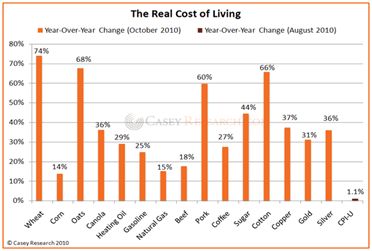
What is unnerving to our eyes is the likely continued rise in food and energy prices, unless QE2 is reversed. This chart courtesy of Casey's Daily Despatch shows how much the basic ingredients for households have risen so far this year. As we said in a previous note what the Fed gives with one hand it takes away with another, but, this time, to hurt the very households that the Fed is supposed to help.
Under current Ponzi related conditions, we should recognise the futility of economic forecasting. Instead we should focus on the more secure knowledge that bubbles always burst and that following severe financial crises, economic growth is slow until debt is expunged from the system.
Bubbles have rest periods. At some point, markets will have run their course for the time being and this might well be in early 2011, from which declines in equity and commodity markets should be experienced.
This will be followed by that last sharp move up in these markets, which we have been forecasting with copper going to $12,000 or even higher. Such a price won't be driven by real fundamentals as we keep saying, but by financial markets. Speculation will be rampant probably even more than it is today, being part of the bubble environment.
Whether the bursting of the financial asset bubble will be late next year or a year or so later is anyone's guess. It will herald in real deflation and sharply falling asset prices with copper falling below US$1500 by 2016. In short, what has changed in our forecasts is not the big picture but the short-term timing.
source
As we write, the gold price is about to assault the $1,400 level having been $1,332 on Wednesday of this week, a day ahead of the Fed announcement. Against the pound sterling, the yen the Swiss franc and most other currencies the dollar has weakened too. In the days ahead of that announcement the dollar had been wavering between $1.38 and $1.40 against the euro. After the announcement the U.S. dollar fell quickly down to $1.42 against the euro. But then the dollar recovered a little and is sitting at $1.41. Recently gold has again moved in the opposite direction to the dollar, until it ran up in the euro vigorously, so has this now changed again? Can there be more to the rise in gold than just the fall in the dollar? We believe so, because far more than QE 2 happened this past week.
DID THE MID-TERM ELECTIONS AFFECT THE PRICE OF GOLD?
In the run-up to and after the announcements of the results of the U.S. mid-term elections the gold price barely moved. On the surface we can therefore conclude that the mid-term U.S. elections did not affect the gold price. But whether the Republicans or the Democrats won is not an issue for the gold market. What is an issue for precious metals is, can the U.S. government govern in the monetary area sufficiently to invigorate the U.S. economy and should it wish to do so, strengthen the U.S. dollar?
We found the result pointed to an emasculation of the government's power on the monetary front. Far too much of a burden has fallen on the shoulders of the Federal Reserve, an institution with only limited powers to resuscitate the U.S. economy. Government should shoulder that role, supported in this by the Fed. Government does not appear to now have the capacity to resolve the economic problems of the U.S. This tells us that the enormous steps needed to be taken to strengthen the U.S. dollar are not going to be taken, so a fall in the U.S. dollar is widely expected. The difference for the dollar now is that its fall can be precipitous and not simply a repeat of the fall in the last two years. Control over the dollar's value for the next two years appears to have slipped from the grasp of the U.S. monetary authorities. This is extremely positive for the gold price.
DID THE FED ANNOUNCEMENT OF Q.E. 2 AFFECT THE PRICE OF GOLD?
Ahead of the announcement a ‘bear raid' on gold was mounted that had the gold price drop from $1,358 down to $1,332 in a steep dive that shook the weak holders and triggered more than a few ‘stop loss' positions. Ordinarily, this would have been enough to deter investors, but it happened when the market was seeing thin volumes of trade, hence the size of the fall. On the announcement these bears received a very sharp silver coated, golden horn in the sensitive parts and rose like a space shuttle breaking up through the fifties and sixties and on through resistance at $1,370. Right now we are tapping $1,400.
Undoubtedly the activity of buyers looking for physical gold from most gold markets in the world was the primary driver. But add to this the scramble of short covering that is now going on. The short covering comes not only from those who went short ahead of the announcement but from longer-term shorts, realizing that the breakout to new levels is well founded on fundamental factors. The announcement from the Fed established those fundamentals. However, a greater and greater proportion of gold investment buying globally is due to a growing fear of the global currency system itself!
WHAT ARE THE RAMIFICATIONS OF THE FED'S ANNOUNCEMENT?
The entire financial world had been waiting for weeks for the Fed to make this announcement. It was important because it directly affects the value of the dollar inside and outside the U.S. While the U.S. does not intend to cause a devaluation that will enhance the international competitiveness of the U.S., that is what is happening. That is how the rest of the world will see it. They will take action in their own interests to protect themselves. They have to or see themselves suffer as the U.S. has been doing so for some time now. This will have three primary effects on the global economy: -
•1. The U.S. will lose the cooperation it had hoped for with China and other nations who it asked to let their currencies rise but who will now suffer from a lower dollar, such as China. Global monetary cooperation, sorely needed now, will decay. Currency crises in different nations will be inevitable as they each strive to protect their own interests.
•2. Foreign investment capital channeled into the U.S. and badly needed there, will accelerate its diversification from the dollar. This will accelerate the fall of the dollar and see capital exit the U.S. To the extent this happens it will act as a counter to QE 2.
•3. It will undermine the dollar's global hegemony, which in itself will create considerably more uncertainty as to exchange rates and values.
Julian Phillips is a long time precious metals analyst and is the principal writer on www.goldforecaster.com and www.silverforecaster.com
source
The good news for U.S. hardrock miners is that the son of a hardrock miner, Harry Reid, the majority leader of the U.S. Senate, was re-elected by his fellow Nevadans.
The bad news for U.S. coal miners is that Sen. Harry Reid, D-Nevada, was re-elected to the U.S. Senate and should retain his post as majority leader of the U.S. Senate, as well as his disdain for coal-fired power plants.
More bad news for U.S. mining, however, as President Barack Obama still controls the executive branch, including all federal agencies which regulate domestic mining. Mountaintop mining will remain a hot button issue for the administration, as will the EPA's insistence on regulatory supremacy in permitting of Clean Water Act permits pertaining to mining.
Alaska Senator Lisa Murkowski's write-in re-election bid remains a hot race that may take weeks to decide. However, if pro-hardrock mining Murkowski retains her Senate seat, she may also remain the ranking minority member on the Senate Natural Resources Committee.
Republicans now control the House, which usually means good news for the U.S. mining sector, both coal and hardrock mining. It also means that House committees chaired by prickly Democrats will now be chaired by Republicans.
West Virginia Gov. Joe Manchin has been elected to fill the senate seat vacated by the death of Robert Byrd, a fellow Democrat. Manchin's family comes from coal mining roots, and the governor has become very adept at walking the tightrope between coal mining companies and EPA and MSHA.
Meanwhile, Republicans also managed to hang on to Senate seats representing the mining states of Arizona, Missouri and Utah.
To the delight of gold miners and the consternation of coal miners, Rep. Nick Rahall, D-West Virginia, is no longer the chairman of the House Natural Resources Committee. The presumptive chairman of Resources is Rep. Doc Hastings of Washington State.
In a statement issued Wednesday, Hastings promptly proclaimed, "Creating new jobs and giving a much needed boost to the economy will also be at the forefront of our agenda."
"Through the responsible stewardship of our natural resources we can put Americans to work, strengthen our economy and protect the environment," he said. "This includes increasing domestic energy production through an all-of-the-above energy plan and ensuring that public lands are actually open to the public. The livelihoods of rural communities, especially in the West, are dependent on the smart use of our public lands, water, timber, minerals and energy resources."
"Finally, the Committee will provide much needed oversight of the Obama Administration's policies that have largely gone unchecked for nearly two years," Hastings declared. "Our goal will be to hold the Administration accountable and get much needed answers on a range of issues including the de facto offshore drilling moratorium in the Gulf, potential new monument designations and plans to lock up vast portions of our oceans through an irrational zoning process."
Meanwhile, Rahall faces the dilemma of remaining as the ranking member on the Resources Committee or replacing the defeated Jim Oberstar as the ranking member of the powerful House Transportation Committee. House rules suggest Rahall may not be able to occupy both posts. Oregon Rep. Peter DeFazio, a Democrat, also has a strong claim on becoming the ranking member of Transportation although Rahall is ahead of him in seniority.
However, fellow Minnesota Congressman John Kline, a Republican, did not suffer stinging defeat of Oberstar, D-Minn., the formerly powerful chairman of the Transportation Committee. Kline is now considered the heavy favorite to replace liberal George Miller, D-California, as chairman of the House Education and Labor Committee. Miller could choose to remain as the ranking member of Education and Labor, continuing his crusade to toughen mine safety.
New Jersey Rep. Frank Pallone--a Democrat who is a strong environmentalist and an equally formidable opponent of the energy industry--could also become the ranking member on the House Resources Committee if Rahall choses the Transportation Committee.
Rep. Dean Heller, R-Nevada, coasted to an easy re-election. However, the gold mining stalwart could be moving on to a more powerful committee, possibly leaving Nevada without a representative on the House Resources Committee. Fellow Nevada representative Dina Titus, a Democrat, was defeated by her Republican challenger, while the third Nevada representative, Shelley Berkley, D-Las Vegas, also coasted to an easy re-election.
The House Energy and Commerce Committee may be chaired by the Texas lawmaker who apologized to BP for the company's treatment by the White House. Rep. Joe Barton. However, Rep. Fred Upton, R-Michigan, is expected to challenge Barton for the post.
Upton believes Republicans should wage war on the EPA for its regulatory train wreck of job killing plans. He also is opposed to the House Democrats call for a climate change panel.
The GOP has already announced plans to stop the EPA's war on mountaintop mining.
Nevertheless, political pundits say the era of sweeping energy and environmental bills may be over for now. But new coalitions could emerge on water rights and river issues, as well as public lands protections.
The action could also shift more heavily to the executive branch, where miners may still remember the days of the Clinton Administration when a GOP-controlled Congress was helpless to stop the anti-hardrock mining machinations of then Secretary of the Interior Bruce Babbitt. Anyone recall the demise of the Crown Jewel gold project outside of Yellowstone, or the 3809 hardrock mining regulations?
Current Interior Secretary Ken Salazar has already banned mining in areas near the Grand Canyon National Park, as well as near some wilderness areas. EPA Administrator Lisa Jackson is moving heaven and earth to expand the use of the Clean Water Act as a tool to ban mining operations and expansion of mining operations.
The game of musical chairmanships has just begun...
